
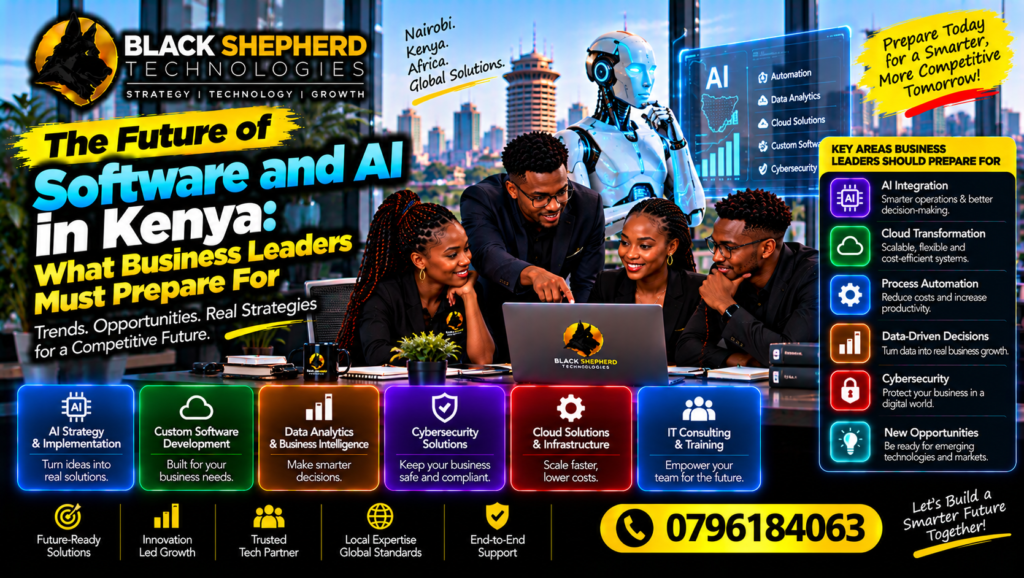
The commercial landscape across East Africa—anchored by Nairobi’s vibrant technological center, the Silicon Savannah—is undergoing an unprecedented structural transformation. Over the past decade, Kenya established itself as a global pioneer in mobile financial services, digital payments, and tech entrepreneurship. Today, we stand at the threshold of an even more profound paradigm shift. The convergence of advanced artificial intelligence, cloud-native custom software engineering, localized machine learning models, and automated digital ecosystems is redefining how trade, finance, logistics, healthcare, and retail operate.
For executive leadership, board members, and business founders across Kenya, navigating this transition is no longer a matter of passive observation or gradual digital adoption. Artificial intelligence and modern software architectures have transitioned from speculative, forward-looking concepts into immediate core operational infrastructure. Companies that proactively adapt their technology roadmaps, modernize legacy systems, upskill their talent, and embed intelligent automation into daily workflows will capture dominant market share. Conversely, enterprises that cling to manual processes and outdated software will face rapid commercial obsolescence.
At Black Shepherd Technologies, we engineer high-performance custom software, enterprise platforms, and localized AI automation workflows tailored specifically for the East African economic environment. If you are auditing your enterprise digital strategy or building next-generation digital products, explore our professional engineering portfolio and projects to see how we bring market-leading technology solutions to life.
In this exhaustive, 3,000-word strategic guide, we will analyze the mega-trends shaping the future of software and AI in Kenya, break down the core operational shifts business leaders must prepare for, evaluate regulatory and data privacy frameworks, and outline a step-by-step roadmap for future-proofing your enterprise.
-
The New Era of Kenyan Digital Commerce: Beyond Basic Digitization
To understand where software and artificial intelligence are headed over the next five to ten years, business leaders must first recognize how fundamentally consumer expectations and enterprise operational needs have evolved in Kenya.
The Death of Passive Digital Interfaces
The era of static brochure websites and simple digital storefronts is officially over. Today’s Kenyan consumer—whether a digital-native retail shopper in Westlands, a wholesale buyer in Eastleigh, or a farmer in Nakuru—demands hyper-personalized, instant, and frictionless digital interactions.
-
Instant Conversational Trade: Consumers no longer want to navigate complex multi-step web menus or wait hours for email replies. They expect intelligent conversational interfaces capable of answering complex inquiries, recommending relevant products, and executing instant order checkouts in natural language.
-
Hyper-Localized Context: Generic global software templates fail because they lack regional context. Modern software must speak the language of the local market—handling English, Swahili, and Sheng fluidly while integrating natively with local payment gateways like Safaricom’s M-Pesa.
From Static Records to Predictive Intelligence
Historically, corporate software served primarily as a digital filing cabinet—recording past transactions, storing customer lists, and generating historical monthly accounting reports. The future of enterprise software is intrinsically predictive and autonomous:
-
Predictive Inventory & Supply Chain: Rather than reacting to stockouts after they occur, machine learning models analyze historical buying cycles, weather patterns, economic indicators, and seasonal surges to forecast exact inventory requirements automatically.
-
Dynamic Credit Scoring & Risk Modeling: Financial institutions and fintechs utilize real-time behavioral data, mobile money velocity, and transactional intelligence to assess creditworthiness in seconds, opening capital access while minimizing non-performing loan default risks.
Whether your organization operates in financial services, retail e-commerce, agriculture, logistics, or professional consulting, aligning your digital infrastructure with modern technological realities is essential. Explore our specialized industries we serve page to see how we build bespoke digital platforms tailored to diverse commercial sectors.
-
Five Technological Mega-Trends Reshaping Kenyan Business
Executive teams preparing their strategic plans must evaluate five core technology mega-trends that will dictate market leadership across Kenya and the broader East African region.
                      5 MEGA-TRENDS SHAPING KENYAN ENTERPRISE TECH

  1. Conversational AI & Multilingual LLMs  ---> Real-time sales in English, Swahili & Sheng
  2. Native M-Pesa & API Interoperability   ---> Frictionless, automated payment settlement
  3. Hyper-Automated Back-Office Systems    ---> Elimination of manual data entry & reconciliation
  4. Mobile-First Edge Computing           ---> Lightning-fast UX across budget & premium devices
  5. Sovereign Cloud & Data Governance      ---> Ironclad compliance with the Data Protection Act
Mega-Trend #1: Conversational AI and Localized Multilingual Models
Generative Pre-trained Transformers (GPT) and Large Language Models (LLMs) are moving beyond basic text generation into autonomous business execution.
-
Multilingual Fluency: Specialized local AI models are being trained to comprehend regional linguistic nuance. An AI agent deployed on a company’s WhatsApp Business API or website chat widget can process a query like “Boss, iko stock ya hizi items na mnaweza deliver Kisumu leo?” with complete understanding, fetching live database inventory, calculating shipping timelines, and generating an automated payment prompt instantly.
-
24/7 Autonomous Sales & Support: Businesses running localized AI agents eliminate after-hours sales leakage, servicing high-intent buyers around the clock without inflating customer support headcount.
Mega-Trend #2: Ubiquitous API Interoperability and M-Pesa Integration
In Kenya, software cannot exist in an isolated bubble. The future belongs to interconnected API ecosystems where data flows seamlessly between separate platforms:
-
Direct M-Pesa Daraja 2.0 Integration: Future-ready enterprise software features native, deep integration with Safaricom’s Daraja API—handling real-time STK Push prompts, automated C2B validation, B2C disbursements, and instant asynchronous webhook callbacks.
-
Unified Financial Rails: Software architectures must bridge traditional bank EFT/RTGS networks, card processing rails (Visa, Mastercard), and regional mobile wallets into a single, unified reconciliation dashboard.
Mega-Trend #3: Hyper-Automation of Back-Office Operations
Manual administrative tasks—such as copying transaction reference codes from phone screens into accounting spreadsheets, manually generating invoices, or cross-checking paper delivery notes—are the single largest drag on corporate profitability.
-
Automated Reconciliation: Modern AI software pipelines parse incoming mobile money payment notifications, match transaction references against open database orders with near-100% accuracy, update accounting ledgers, and clear orders for dispatch within milliseconds.
-
Intelligent Document Processing (IDP): Optical Character Recognition (OCR) combined with machine learning allows enterprise software to scan, extract, and categorize structured data from PDFs, paper receipts, and supplier invoices automatically.
Mega-Trend #4: Cloud-Native Microservices and Mobile-First UX
The hardware landscape across Kenya remains highly diverse. Users access digital platforms across a broad spectrum of hardware—ranging from high-end corporate laptops in Upper Hill offices to budget-friendly Android smartphones running on cellular networks in upcountry towns.
-
Performance Optimization: Future-proof software is engineered with a mobile-first, cloud-native microservices architecture. Light footprint frontends combined with serverless backend APIs ensure that web applications load in under two seconds, regardless of device processing power or network fluctuations.
-
Thumb-Friendly Experience: User interfaces must prioritize thumb-driven navigation, low data consumption, and intuitive visual layouts that minimize cognitive friction.
Mega-Trend #5: Sovereign Cloud Hosting and Data Privacy Governance
With strict enforcement of the Data Protection Act by the Office of the Data Protection Commissioner (ODPC), data governance has become a boardroom priority.
-
Data Residency: Enterprises handling sensitive financial records, health data, or personally identifiable information (PII) must ensure their software platforms adhere to strict encryption protocols, granular role-based access controls (RBAC), and compliant cloud hosting frameworks.
-
Enterprise Security Architecture: Outdated legacy frameworks vulnerable to SQL injection, cross-site scripting (XSS), or unencrypted data transmissions expose companies to catastrophic regulatory fines and brand reputation destruction.
-
What Business Leaders Must Prepare For: Strategic Imperatives
To capture the commercial opportunities presented by AI and advanced software, executive leadership must take decisive, proactive action across four strategic pillars.
                   EXECUTIVE LEADERSHIP ACTION MATRIX

  STRATEGIC PILLAR               IMMEDIATE EXECUTIVE ACTION
  -----------------------------  -------------------------------------------------------------
  1. Technical Architecture      Audit legacy tech debt; transition to modular, API-first stacks.
  2. Data Infrastructure         Unify siloed company databases into structured data lakes.
  3. Talent & Workforce          Upskill staff to manage AI workflows; eliminate repetitive tasks.
  4. Vendor & Engineering Partners  Partner with battle-tested regional software engineering firms.
Imperative #1: Auditing and Eliminating Technical Debt
Many established Kenyan corporations operate on fragile “Frankenstein” software architectures—where legacy core databases are held together by layers of unmaintained plugins, custom Excel spreadsheets, and manual workarounds.
-
The Strategic Risk: Trying to build modern AI capabilities or automated customer portals on top of obsolete, non-API legacy software is like building a skyscraper on a sand foundation.
-
The Action: Conduct a comprehensive technical audit. Identify obsolete software stacks, eliminate single points of failure, and outline a phased modernization roadmap to transition toward scalable, custom-built web applications and microservices.
Imperative #2: Unifying Corporate Data Assets
Artificial intelligence is only as smart as the data fed into it. If your company’s customer records live in one isolated sales folder, inventory data resides in a separate desktop accounting system, and payment history is trapped in raw bank statements, your organization cannot leverage AI effectively.
-
The Action: Consolidate siloed data streams into a unified, secure database or data lake architecture. Clean historical records, enforce standardized data entry protocols, and ensure all customer touchpoints write to a centralized CRM and ERP system in real time.
Imperative #3: Redefining Human Talent and Workforce Dynamics
A common anxiety among executives and employees is that AI automation will render human teams redundant. In practice, successful AI adoption does not eliminate human workers—it elevates them.
-
From Administration to Strategy: When AI chatbots handle 80% of repetitive, routine customer inquiries (“Where is my order?”, “What are your business hours?”), human support staff are freed to focus on high-value client relationships, complex negotiations, and strategic account management.
-
The Action: Invest in organizational upskilling. Train your teams to act as supervisors and managers of AI automation workflows, utilizing intelligent tools to multiply their daily output and focus on strategic business growth.
Imperative #4: Choosing the Right Software Engineering Partner
Building custom software architectures and deploying production-grade AI models requires deep, specialized engineering expertise. Attempting to build complex systems using inexperienced internal staff or off-the-shelf overseas templates often leads to delayed launches, budget overruns, and fragile systems that break under local transaction loads.
-
The Action: Partner with an established, regional software engineering firm that understands both enterprise-grade technology stacks and the unique operational dynamics of the East African market.
-
Real-World Sector Transformation: How AI and Software Reshape Kenyan Industries
To visualize how these technological shifts play out on the ground, let’s examine practical transformation scenarios across key sectors of the Kenyan economy:
Sector A: Retail & E-Commerce
-
The Legacy Paradigm: A shopper visits a website, fills out a multi-step form, transfers money via manual paybill entry, and emails a receipt screenshot to customer support. A staff member manually checks the bank account hours later and dispatches the order.
-
The Future Paradigm: A shopper discovers a product, chats directly with an AI virtual assistant on WhatsApp or web chat in Swahili or English, receives personalized sizing advice, authorizes an instant M-Pesa STK push prompt on their phone screen, and receives real-time automated delivery tracking updates every step of the way.
Sector B: Financial Services & Micro-Lending
-
The Legacy Paradigm: A small business owner fills out paper loan application forms, submits manual physical bank statements, and waits two weeks for a loan committee to evaluate credit risk manually.
-
The Future Paradigm: An AI risk engine evaluates the applicant’s real-time digital transaction velocity, mobile money cash flow patterns, and supply chain invoices via API, scoring creditworthiness and disbursing business capital within two minutes—24 hours a day, 7 days a week.
Sector C: Logistics and Supply Chain
-
The Legacy Paradigm: Dispatchers call drivers individually on the phone to confirm location, record delivery completions on paper manifests, and reconcile cash payments at the end of the week.
-
The Future Paradigm: An integrated fleet software platform optimizes delivery routes automatically, updates customers via automated SMS/WhatsApp alerts, tracks real-time GPS coordinates, and reconciles digital payments instantly upon delivery confirmation.
-
Driving Enterprise Visibility and Growth with Advanced SEO
Engineering world-class custom software platforms and deploying state-of-the-art AI automation tools ensures that when customers interact with your business, they experience unmatched speed, reliability, and friction-free service. However, internal operational excellence is only half of the commercial growth equation; your enterprise must also capture continuous market demand.
If prospective corporate clients, B2B buyers, or retail consumers searching for your products and services online cannot discover your digital platform on search engines, your competitors will capture that market share. Implementing technical SEO, structured schema markup, fast page speed optimization, and targeted local content strategies is essential for dominating search engine results pages. Partnering with professionals providing expert SEO services in Kenya is the most sustainable way to drive high-value organic traffic directly to your digital ecosystem.
Conclusion: The Choice Facing Kenyan Business Leaders
The future of software and artificial intelligence in Kenya is no longer a distant vision—it is an active, rapidly expanding reality. The choices executive leaders make today regarding their technology architecture, software investments, data consolidation, and engineering partnerships will determine their market position for the next decade.
Embracing modern software engineering and localized AI automation is not merely an operational upgrade; it is a foundational strategic pivot that unlocks exponential scalability, eliminates wasteful administrative overhead, builds ironclad customer loyalty, and drives sustainable profitability.
At Black Shepherd Technologies, we empower corporate enterprises, financial institutions, logistics networks, and growing businesses across East Africa with elite custom software engineering, intelligent AI automation workflows, and high-performance digital platforms. Get in touch with our engineering team today to audit your technology roadmap, eliminate technical debt, and build a future-proof digital architecture engineered for market leadership and sustainable growth.
