
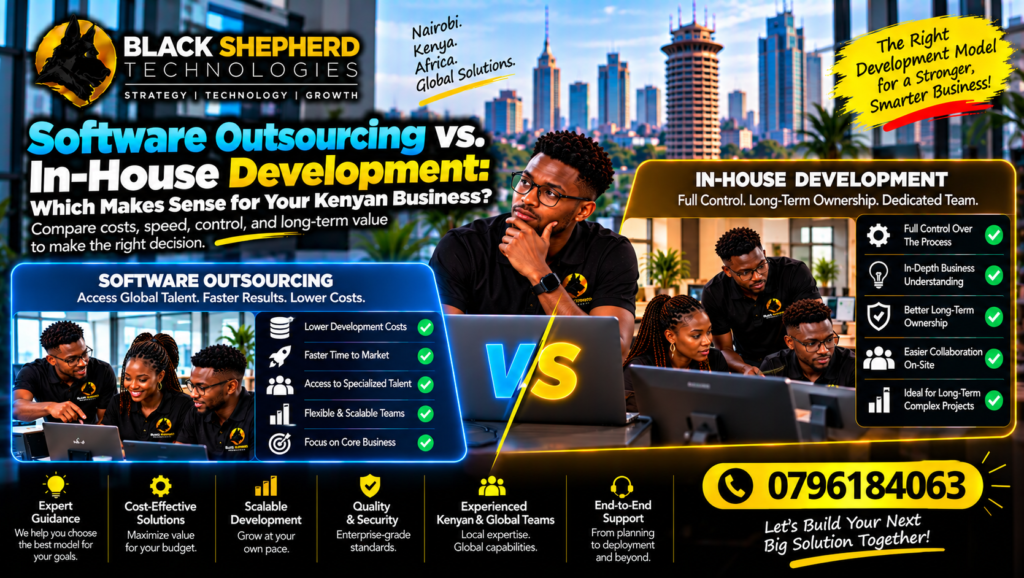
In the fast-moving corporate and technology landscape across East Africa, growing enterprises face a constant, defining imperative: innovate rapidly or risk losing market share. Whether you are leading a fintech venture in Westlands, scaling a multi-branch retail network across Nairobi, managing a regional logistics operation along the Northern Corridor, or modernizing an agricultural supply chain in Nakuru, software lies at the absolute heart of your operational capacity.
When executive leadership determines that a new digital platform, mobile app, internal ERP, or customer portal is required, a pivotal strategic question immediately emerges: Should we build an internal, in-house software engineering team, or should we outsource development to a specialized technology partner?
This decision is far from a simple HR exercise. It fundamentally shapes your capital expenditure, operational flexibility, time-to-market, risk exposure, and long-term technological agility. In Kenya’s unique economic environment—where digital products must seamlessly integrate with local payment rails like Safaricom’s M-Pesa, comply with strict data protection regulations, and handle unpredictable market dynamics—making the wrong architectural or staffing choice can cost millions of shillings in lost time and bloated overheads.
At Black Shepherd Technologies, we engineer enterprise software, custom web applications, and high-performance mobile platforms tailored specifically for the East African economic ecosystem. If you are scaling your digital infrastructure or evaluating software architecture options, explore our professional engineering portfolio and projects to see how we build market-leading technology solutions.
In this exhaustive, 3,000-word decision-making guide, we will break down the true mechanics of software outsourcing versus in-house development for Kenyan enterprises, examining the total cost of ownership, local developer talent dynamics, project risks, speed-to-market, and hybrid execution models.
-
Understanding the Options: In-House vs. Outsourced Software Engineering
Before evaluating financial metrics, executive teams must clearly define what each development model entails within the East African context.
The In-House Development Model
Building an in-house software development team means hiring full-time software engineers, UI/UX designers, QA testers, project managers, and DevOps specialists directly onto your company’s payroll.
-
Operational Reality: Your organization assumes full responsibility for recruitment, monthly salaries, statutory benefits (PAYE, NSSF, SHIF/NHIF), hardware provisioning, office space in commercial hubs like Upper Hill or Kilimani, software licensing, and continuous career development.
-
Management Burden: Executive leadership or an internal Chief Technology Officer (CTO) must manage daily agile sprints, technical architecture decisions, code reviews, and project timelines.
The Software Outsourcing Model
Outsourcing software development involves partnering with an established, specialized technology agency or engineering firm that designs, builds, tests, and deploys your software solution based on agreed project scopes, milestones, and SLAs (Service Level Agreements).
-
Operational Reality: The outsourcing partner provides an established, multi-disciplinary team of senior engineers, system architects, and project managers. Your company pays for project milestones or a dedicated retainer, completely bypassing HR recruitment overheads and long-term payroll liabilities.
-
Management Burden: Your team acts as the product owner, focusing strictly on business requirements and strategic outcomes while the agency manages daily technical execution.
Whether you operate in retail, manufacturing, logistics, or healthcare, tailoring your technology infrastructure to match your organizational goals is critical. Explore our specialized industries we serve page to see how we build custom software platforms tailored to diverse commercial sectors.
-
The Developer Talent Reality in Kenya: Hiring, Salary, and Churn Dynamics
To make an informed choice between building in-house or outsourcing, executive leadership must understand the realities of the software engineering talent market in Nairobi and across East Africa.
The Talent Shortage and Global Poaching
Kenya has built a deserved reputation as Africa’s premier technology hub (“Silicon Savannah”). However, high-caliber, senior full-stack developers, mobile engineers (Flutter/React Native), and cloud architects remain in short supply.
-
Global Competition: Remote work trends mean top-tier Kenyan developers are routinely recruited by international tech giants and European/US firms offering salaries denominated in USD or Euros.
-
SME & Corporate Squeeze: Local enterprises frequently struggle to match foreign remote salary rates, leaving many local companies with junior talent that requires extensive hand-holding and training before delivering production-ready code.
The Hidden Cost of Talent Turnover (Churn)
In Nairobi’s tech ecosystem, the average retention period for a mid-to-senior software developer in an in-house corporate role is often between 12 and 18 months.
-
When a key lead developer resigns mid-project, development halts entirely.
-
Knowledge transfer is rarely seamless, and onboarding a replacement engineer can take two to three months, causing severe project delays and budget overruns.
When you outsource to an established engineering partner, talent churn risk is transferred entirely to the agency. A professional technology firm maintains a deep bench of senior engineers. If an individual developer transitions off your project, the agency replaces them immediately with another vetted engineer without delaying your delivery roadmap.
-
Total Cost of Ownership (TCO): A Financial Breakdown
A common misconception among business leaders is that outsourcing software development is more expensive than hiring an in-house team. When you conduct a rigorous Total Cost of Ownership (TCO) analysis over a 12-to-24-month horizon, the financial reality is often surprising.
The True Cost of an In-House Software Team in Kenya
Building even a modest, four-person in-house development team (1 Lead Architect, 1 Senior Full-Stack Dev, 1 Mobile Dev, 1 UI/UX & QA Specialist) incurs substantial direct and indirect costs:
-
Direct Salaries: Competitive monthly compensation for senior, battle-tested developers in Nairobi ranges significantly. A four-person team can easily require KES 800,000 to KES 1,500,000+ per month in direct payroll.
-
Statutory Benefits & Taxes: Employer contributions toward NSSF, SHIF/NHIF, housing levies, and payroll taxes add 10% to 15% on top of gross salaries.
-
Recruitment & Headhunting Fees: Finding qualified tech talent through recruitment agencies typically costs 10% to 20% of an engineer’s annual salary per placement.
-
Hardware & Infrastructure: High-performance laptops (e.g., MacBook Pros), dual-monitor workstations, cloud development environments, and software licensing (Jira, GitHub Enterprise, Figma, IDEs) require substantial upfront capital.
-
Office Space & Administrative Overhead: Rent, high-speed fiber internet, electricity, HR support, and team training continuous expenses.
-
Idle Time Liability: When project development phases end and software transitions into routine maintenance, your full in-house monthly payroll costs continue unabated regardless of actual workload requirements.
The Financial Dynamics of Outsourcing
When you outsource custom software development to a specialized partner, your financial structure transitions from fixed, heavy monthly overheads to predictable, variable project investments:
-
Zero Infrastructure or Recruitment Capital: You pay strictly for defined deliverables, milestones, or agreed monthly sprint hours.
-
No Idle Cost Overhead: Once the core software product is built and launched, you scale down your engagement to a manageable monthly maintenance and hosting retainer, calling on specialized developers only when major updates are required.
-
Budget Certainty: Fixed-scope or milestone-based contracts shield your enterprise from budget inflation caused by development inefficiencies.
-
Speed-to-Market and Operational Agility
In today’s competitive business environment, time-to-market is frequently the difference between capturing a lucrative market segment and falling behind an agile competitor.
The In-House Onboarding Delays
If you decide to build an in-house team today, your timeline typically unfolds as follows:
-
Weeks 1–6: Drafting job descriptions, screening resumes, conducting technical coding assessments, and interviewing candidates.
-
Weeks 7–10: Managing notice periods (most senior engineers in Kenya must serve a 30-to-60-day notice period at their current employer).
-
Weeks 11–14: Hardware procurement, internal onboarding, establishing coding standards, and setting up DevOps pipelines.
Result: 3 to 4 months pass before a single line of production code is written.
The Outsourced Rapid Kick-off
By contrast, an established software agency maintains pre-assembled, cross-functional teams equipped with battle-tested development frameworks, CI/CD pipelines, and reusable code libraries.
-
Project discovery and architectural scoping begin immediately.
-
Development sprints kick off within days of project sign-off.
-
A complete Minimum Viable Product (MVP) or enterprise web application can often be built, tested, and launched in the time it would take just to recruit an in-house team.
-
Deep Domain Expertise & Localized API Integration
Building software in East Africa requires far more than generic coding knowledge. It demands deep experience with regional payment systems, regulatory compliance, multi-channel user journeys, and localized consumer behavior.
The Challenge of M-Pesa & Regional Integrations
A generic software application built without local context will struggle at checkout. In Kenya, your software must communicate flawlessly with local financial and operational systems:
-
Safaricom Daraja API: Handling STK Push triggers, C2B validation/confirmation URLs, B2C payouts, and asynchronous webhook callbacks.
-
Multi-Currency & Card Aggregators: Integrating platforms like Pesapal or IntaSend for international credit/debit card processing.
-
KRA ETIMS & Regulatory Rails: Syncing commercial transactions with tax compliance systems.
-
USSD and WhatsApp Integration: Reaching mass-market consumers who prefer non-app mobile interfaces.
An in-house developer who has never integrated Safaricom’s Daraja API or built complex asynchronous webhook handlers will waste weeks troubleshooting sandbox errors, token expiration bugs, and network timeout edge cases.
Conversely, an experienced local software engineering firm has executed dozens of M-Pesa integrations across diverse platforms. They deploy battle-tested SDKs, security encryption protocols, and error-handling routines out of the box, ensuring your financial transactions clear instantly and securely.
-
Risk Management: Security, IP, and Quality Assurance
Executive leadership often cites risk management—specifically source code security, intellectual property (IP) protection, and quality control—as a primary concern when evaluating outsourcing.
Managing Intellectual Property and Security in Outsourcing
To ensure absolute protection when outsourcing software development in Kenya, insist on clear contractual guardrails:
-
Unconditional IP Ownership: Ensure your contract explicitly states that all source code, design assets, database structures, and intellectual property belong 100% to your company upon milestone payment.
-
Comprehensive Non-Disclosure Agreements (NDAs): Execute legally binding NDAs protecting your business logic, customer data, and trade secrets before sharing documentation.
-
Data Protection Act Compliance: Ensure your technology partner complies fully with the Kenya Data Protection Act, incorporating end-to-end data encryption, secure cloud hosting, and role-based access controls.
Quality Assurance (QA) and Testing Standards
In-house teams working under tight deadlines often treat testing as an afterthought, leading to buggy software releases that frustrate users. Professional outsourcing agencies maintain dedicated, independent Quality Assurance (QA) engineers who subject every software release to automated testing, performance stress tests, vulnerability scanning, and cross-device compatibility checks before deployment.
-
The Decision Framework: When to Build In-House vs. When to Outsource
To simplify your decision, run your project through the following clear evaluation framework:
                          BUILD VS. BUY / OUTSOURCE MATRIX

                   Core Intellectual Property & Unique Innovation?
                                      /        \
                                     /          \
                                  YES            NO
                                  /                \
           Does your firm have the capital,         OUTSOURCE TO A
           time (6+ mo), and HR capacity            SPECIALIZED AGENCY
           to recruit & retain senior tech?         (Fastest time-to-market,
                         /        \                 lower TCO, zero HR liability)
                        /          \
                     YES            NO
                     /                \
             BUILD IN-HOUSE       HYBRID MODEL
             (Full control,       (Outsource core launch to agency;
              long-term internal   transition to small internal
              engineering team)    maintenance team post-launch)
When Outsource Makes Absolute Sense
-
You need to launch fast: You cannot afford 3 to 6 months of recruitment delays and need an MVP or enterprise application in the market quickly.
-
Software is an operational enabler, not your core business: You are a logistics firm, retail chain, real estate company, or healthcare provider that needs brilliant software to run operations, but your core business is not selling software code.
-
You lack internal technical leadership: You do not have a veteran CTO capable of evaluating code quality, managing agile sprints, and making complex cloud infrastructure choices.
-
You want budget certainty: You prefer milestone-based, fixed-cost pricing over open-ended monthly payroll liabilities.
When Building In-House Makes Sense
-
You are a core tech company: Your software source code IS your primary commercial product (e.g., a pure-play SaaS startup competing on algorithm design).
-
You have deep capital reserves and long timelines: You have secured substantial capital and can afford to wait 6 to 12 months to recruit, onboard, and train a senior team.
-
Your requirements change daily: You require constant, unpredictable daily pivots that make scoping project milestones difficult.
The Best of Both Worlds: The Hybrid Model
Many successful Kenyan enterprises adopt a Hybrid Model:
-
Phase 1 (Outsourced Launch): Partner with an expert engineering agency to design, build, and launch the core software platform rapidly and securely.
-
Phase 2 (Post-Launch Support): Retain the agency for hosting, security, and major version updates while gradually hiring a small internal IT manager to handle basic day-to-day administrative support.
-
Scaling Your Platform with Enterprise SEO and Visibility
Building a world-class, custom software platform—whether in-house or outsourced—ensures that when users interact with your digital brand, they experience seamless performance, speed, and security. However, brilliant software must be paired with continuous customer acquisition.
If potential corporate clients or consumers searching for your products and services online cannot find your web application or platform on Google, your competitors will capture that market share. Implementing technical SEO, structured schema markup, optimized landing pages, and local search strategies is essential for dominating local search engine results pages. Partnering with professionals providing expert SEO services in Kenya is the most sustainable way to drive high-value organic traffic directly to your digital storefront.
Conclusion: Making the Strategic Choice for Your Enterprise
Choosing between software outsourcing and in-house development is a decision that defines your organization’s growth trajectory. Building in-house gives you direct operational oversight, but incurs heavy fixed costs, recruitment friction, and talent retention liabilities. Outsourcing transfers technical risk, dramatically accelerates your time-to-market, and provides immediate access to senior engineering talent and battle-tested M-Pesa integrations without adding permanent payroll burdens.
For the vast majority of growing Kenyan enterprises looking to maximize ROI, innovate rapidly, and remain lean in a competitive market, outsourcing custom software development to a trusted regional technology partner represents the most prudent, scalable, and profitable strategic path forward.
At Black Shepherd Technologies, we empower businesses across East Africa with elite software engineering, custom application architecture, and high-performance digital platforms. Get in touch with our engineering team today to discuss how we can accelerate your software roadmap, optimize your technical architecture, and fuel your long-term business growth.
