Sentiment Analysis Kenya:

-
Delivery Time2 Weeks
-
English levelProfessional
-
LocationUSA, United Kingdom, United Arab Emirates, Nairobi, Kilimani, Kenya, Dubai, CBD Nairobi, Canada, Australia
Service Description
The cost of Sentiment Analysis in kenya is 250000KES.Get Sentiment Analysis in kenya at a price of 200000KES at Black Shepherd Technologies.
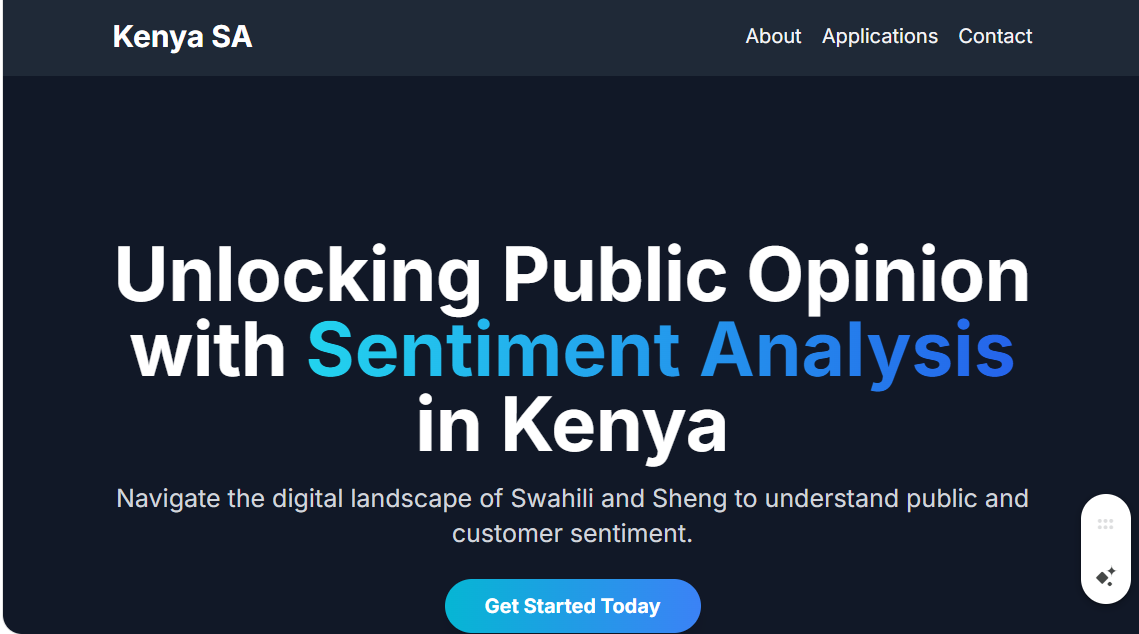
Explore sentiment analysis in Kenya, a burgeoning field using AI and NLP to understand public opinion. This detailed overview covers key applications in banking and governance, the unique challenges posed by linguistic diversity and Sheng, and the innovative local solutions being developed to create culturally-aware models for more accurate insights.
Sentiment analysis, also known as opinion mining, is a field of Natural Language Processing (NLP) that aims to determine the emotional tone behind a body of text. In Kenya, this technology is gaining traction as a powerful tool for businesses, government agencies, and researchers to understand public opinion from the vast amount of data generated on social media, in customer reviews, and on other digital platforms.
Applications and Use Cases
The applications of sentiment analysis in the Kenyan context are diverse and growing. A key area is customer experience management. Companies, particularly in the banking and finance sector, are using sentiment analysis to monitor social media discussions and app reviews to gauge customer satisfaction, identify pain points, and respond to feedback in real-time. For example, a recent Kenya Banking Sentiment Index tracked hundreds of thousands of social media posts to benchmark consumer sentiment towards major retail banks, revealing which factors drive positive and negative customer experiences.
Beyond the corporate world, sentiment analysis is being applied to public policy and governance. Researchers have developed models to analyze public participation forums in county governments, helping to bridge communication gaps and strengthen the devolution process by understanding citizens’ views on government projects. The technology can also be used in other critical areas, such as crime detection and crisis management, by analyzing social media posts to identify negative opinions and potential threats.
Challenges and Innovations
While the potential of sentiment analysis in Kenya is significant, it is not without its challenges. The primary obstacle is the country’s rich linguistic diversity. Most sentiment analysis tools are trained on languages like English, and struggle to accurately process the nuances of local languages and dialects. A major challenge is the prevalence of Sheng, a dynamic and ever-evolving mix of Swahili, English, and other local languages. Idiomatic expressions, sarcasm, and code-switching are also difficult for standard models to interpret correctly.
To overcome these hurdles, there is a growing body of work focused on creating localized solutions. Researchers are developing and fine-tuning models specifically for Swahili and other Kenyan languages. Initiatives like the creation of a “Swahili Lexicon for Sentiment Analysis” and the use of multilingual models like BERT are paving the way for more accurate and culturally sensitive analysis. There is a strong focus on building high-quality, annotated datasets of Kenyan languages to train these models effectively. This is a crucial step, as the accuracy of sentiment analysis is highly dependent on the quality and relevance of the training data.
The Future of Sentiment Analysis in Kenya
The landscape of sentiment analysis in Kenya is rapidly evolving. The increasing adoption of mobile internet and social media means an ever-growing pool of data for analysis. As local researchers and tech companies continue to develop more sophisticated models that are sensitive to cultural and linguistic nuances, the capabilities of sentiment analysis will expand. This will enable more data-driven decision-making across various sectors, from refining marketing strategies and improving customer service to fostering more effective public participation and even aiding in public safety. The future promises a more localized, accurate, and powerful application of this technology, making it a critical tool for understanding the “voice of the customer” and the “voice of the citizen” in Kenya.Sentiment analysis in Kenya is a rapidly evolving field that is becoming a crucial tool for a wide range of stakeholders, from businesses to government and researchers. The country’s unique linguistic landscape, characterized by the widespread use of Swahili, English, and the dynamic urban slang Sheng, presents both significant challenges and opportunities for innovation.
The main challenge lies in the inadequacy of standard sentiment analysis models, which are primarily trained on English, to accurately process and interpret the nuances of Kenyan languages and code-switching. This has spurred a growing body of work dedicated to creating localized solutions, including the development of Swahili-specific lexicons and the fine-tuning of multilingual models on curated Kenyan datasets. This research is critical for improving accuracy and ensuring that sentiment analysis can be effectively applied to the rich and diverse data generated by Kenyans.
Despite these challenges, the applications of sentiment analysis are proving to be immensely valuable. Kenyan companies are leveraging this technology to gain a competitive edge by analyzing customer feedback on social media and app reviews to improve customer service, identify product pain points, and tailor their marketing strategies. Beyond the corporate sphere, sentiment analysis is playing a role in public policy by helping government agencies understand citizen sentiment on various initiatives and improving public participation in governance.
In conclusion, sentiment analysis in Kenya is at a pivotal stage of development. The future of this technology in the country is not merely about adapting existing models but about building new, culturally and linguistically sensitive tools. As more localized datasets are created and more sophisticated models are developed, sentiment analysis will become an even more powerful and accurate tool for generating actionable insights from the vast and growing pool of digital data, ultimately fostering more informed decision-making and a deeper understanding of public opinion across various sectors.