
The digital landscape in Kenya has evolved past the era where simply having a website guaranteed online visibility. Today, Nairobi’s bustling commercial hubs—from Westlands and Upper Hill to the CBD and Industrial Area—are home to fierce digital competition. Whether you run an e-commerce platform in Mombasa, a boutique hospitality venture, or an enterprise service agency, the question that keeps modern founders and marketing directors awake at night is simple yet profound: Where should I allocate my marketing budget to secure sustainable growth?
When mapping out a digital strategy, business leaders almost always hit the classic crossroad: Search Engine Optimization (SEO) versus Google Ads (Pay-Per-Click / PPC).
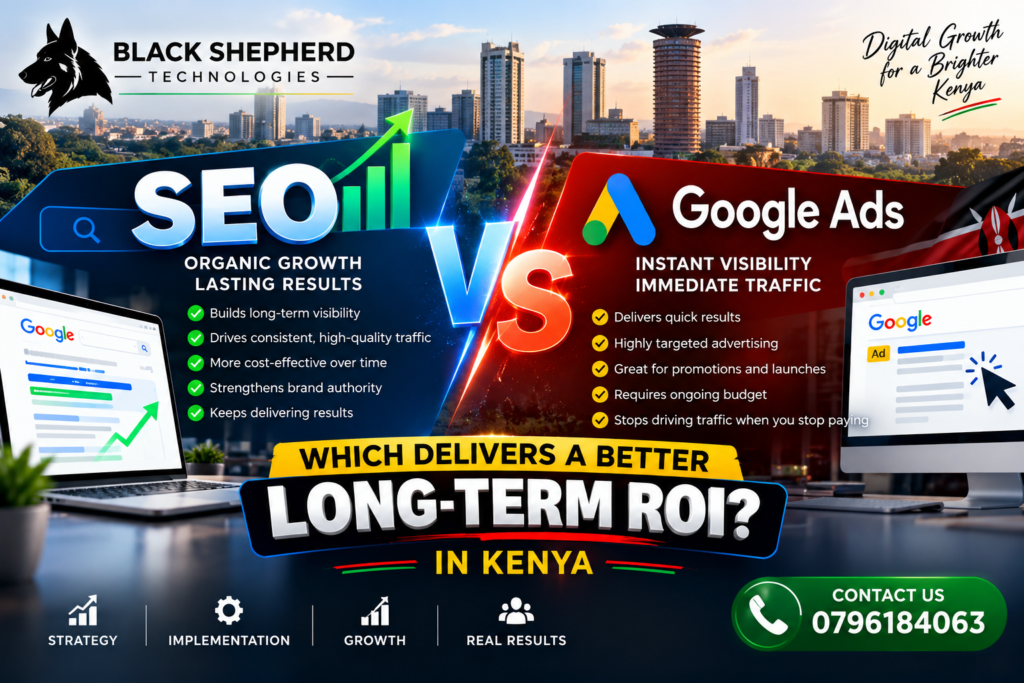
While Google Ads offers instant gratification—placing your brand at the very top of Search Engine Results Pages (SERPs) within hours—SEO builds an organic fortress that compounds in value over years. To make an informed decision tailored to the unique economic realities of the Kenyan market, we need to look beyond the surface-level metrics and analyze how both channels impact your long-term Return on Investment (ROI).
The Kenyan Digital Context: Consumer Behavior and Search Intent
Before evaluating the financial mechanics of SEO and Google Ads, it is critical to understand how Kenyan consumers behave online.
Kenya boasts one of the highest mobile penetration rates in Africa, with smartphones serving as the primary gateway to the internet. M-Pesa has revolutionized digital transactions, turning mobile devices into frictionless checkout counters. When a Kenyan consumer or business buyer needs a product, service, or solution, they do not turn to the yellow pages; they pull out their phone and type a query into Google.
However, Kenyan search intent varies wildly depending on urgency and industry:
-
High-Intent Commercial Searches: Queries like “best web designer SEO services in Nairobi Kenya” or “solar inverter installation cost Kenya” indicate users who are deep in the consideration or decision-making phase. They are actively looking to hire or buy.
-
Informational Searches: Queries like “how to optimize e-commerce checkout for M-Pesa” reflect users seeking knowledge, presenting an opportunity for long-term brand authority.
Understanding how your target audience searches dictates whether capturing traffic via instant paid placements or cultivating organic dominance will yield the superior long-term payoff.
Decoding Google Ads: The Power of Instant Visibility
Google Ads operates on a Pay-Per-Click (PPC) model. You bid on specific keywords relevant to your business, and every time a user clicks your ad, you pay a fee.
The Advantages of Google Ads in Kenya
-
Immediate Traffic and Leads: Unlike organic strategies that require months of technical work, a properly configured Google Ads campaign can start driving targeted traffic to your landing pages within hours of approval. For new businesses launching in Nairobi or companies rolling out time-sensitive campaigns, this speed is unmatched.
-
Precise Geo-Targeting and Demographic Control: Google Ads allows you to hyper-target your audience down to specific neighborhoods (e.g., Kilimani, Karen, or Westlands), specific times of day, and even device types. If you want your ads to show only to users searching from business districts during office hours, Google Ads makes it seamless.
-
High Predictability and Scalability: Once you establish a profitable Customer Acquisition Cost (CAC) and a positive ROAS (Return on Ad Spend), scaling your revenue is theoretically as simple as increasing your daily budget.
The Hidden Costs and Limitations of Google Ads
While Google Ads is a formidable growth engine, it comes with structural vulnerabilities, particularly in emerging markets:
-
The Tap Stops When You Stop Paying: The moment you pause your campaign or exhaust your monthly advertising budget, your visibility drops to absolute zero. You do not own your rankings; you rent them on a continuous auction basis.
-
Escalating Cost-Per-Click (CPC): As more Kenyan enterprises realize the power of digital acquisition, competition for high-value keywords drives up CPCs. If your profit margins are tight, managing ad spend efficiency can become an uphill battle.
-
Ad Fatigue and Banner Blindness: Modern internet users in Kenya are increasingly sophisticated. Many instinctively skip sponsored search results, reserving their trust for organic listings that appear further down the page.
Exploring SEO: Building an Organic Digital Asset
Search Engine Optimization (SEO) is the systematic process of optimizing your website’s architecture, content, technical performance, and authority profile to rank organically for high-value search queries.
Executing world-class SEO requires deep technical expertise—from optimizing Core Web Vitals and server response times to structuring programmatic content matrices. Organizations looking to dominate search listings often partner with specialists who understand the nuances of the local market, such as those providing dedicated SEO services in Kenya.
Why SEO Delivers Superior Long-Term ROI
-
Compounding Returns Over Time:
The defining economic characteristic of SEO is its compounding nature. When you invest in writing high-intent content, acquiring authoritative backlinks, and streamlining your site speed, those assets do not expire. A blog post or optimized service page ranking on page one can drive qualified leads month after month, year after year, without you paying for every single click.
-
Unmatched User Trust and Credibility:
Organic results carry inherent authority. Kenyan consumers frequently perceive top organic rankings as a sign of industry leadership and trustworthiness. Earning your spot on page one signals that Google’s algorithm deems your business the most relevant and reliable answer to the user’s query.
-
Lower Long-Term Customer Acquisition Cost (CAC):
While upfront SEO investment can be substantial—requiring technical audits, content creation, and continuous optimization—the marginal cost of acquiring an additional click or lead trends toward zero over time. In contrast, every single visitor from Google Ads carries a recurring marginal cost.
-
Holistic Brand Impact:
Comprehensive SEO work improves your entire digital ecosystem. Fixing mobile usability issues, accelerating site speed, and clarifying your site structure not only boosts search rankings but also dramatically improves conversion rates for all traffic sources—including direct visitors and social media referrals. Reviewing a proven portfolio of projects can provide clear insight into how technical optimization transforms raw digital infrastructure into high-performing lead generation engines.
The Challenges of SEO
-
Time Horizon: SEO is a marathon, not a sprint. In competitive niches within Kenya, seeing significant movement can take anywhere from 4 to 12 months. Businesses seeking overnight sales often struggle with this runway requirement.
-
Algorithm Volatility: Search engine algorithms update frequently. Without continuous monitoring and technical upkeep, rankings can fluctuate.
Head-to-Head Financial Comparison: Short-Term vs. Long-Term ROI
To determine which channel delivers a better long-term ROI, let’s look at a financial projection model over a 36-month horizon.
| Metric | Google Ads (PPC) | Search Engine Optimization (SEO) |
| Time to First Results | Immediate (1–3 days) | Delayed (4–12 months) |
| Cost Structure | Continuous recurring expense (CPC-based) | Front-loaded investment transitioning to maintenance |
| Asset Ownership | Renting visibility; stops when budget stops | Owning digital real estate that compounds |
| Trust & Click-Through Rate (CTR) | Lower CTR; users often skip ads | Higher CTR; users favor organic results |
| 36-Month ROI Trajectory | Linear growth capped by ad spend budget | Exponential/Compound growth curve |
The Math of Compounding
Imagine Company A spends KES 100,000 every month on Google Ads for 36 months, totaling KES 3.6 million. Each month, that budget buys a fixed volume of traffic. If ad costs rise by 15% year-over-year due to increased competition in Nairobi, the volume of traffic decreases unless the budget is aggressively scaled.
Now consider Company B invests KES 100,000 per month into comprehensive SEO and content architecture for the first 12 months (KES 1.2 million), and then reduces spending to a modest KES 30,000 monthly maintenance retainer for months 13 through 36 (KES 720,000), bringing total 3-year expenditure to KES 1.92 million.
By month 12, Company B’s organic rankings are established. By month 24, they are capturing thousands of high-intent clicks daily without paying per click. Their cost per acquisition plummets, and their long-term ROI dramatically outpaces Company A, despite spending significantly less overall over the 3-year period.
Tailoring the Strategy to Your Industry
Different business models require different strategic weightings between paid search and organic optimization. Across diverse sectors, tailored digital strategies are essential for maximum impact. Examining the industries we serve highlights how tailored digital execution adapts to everything from retail and e-commerce to heavy manufacturing, professional services, and logistics.
1. E-Commerce and Retail
E-commerce brands juggling hundreds or thousands of product SKUs face a unique challenge. While Google Shopping and paid search ads are exceptional for promoting seasonal flash sales or new product drops, relying solely on ads for low-margin retail items can quickly erode profitability. Integrating robust programmatic SEO for category and product pages ensures sustainable traffic from buyers searching for specific product attributes.
2. Professional and B2B Services
Law firms, financial consultants, software development agencies, and corporate service providers thrive on high-value, long-lifecycle contracts. For these businesses, a single high-value client acquired via organic search can pay off the entire annual SEO investment manifold. Trust and authority are paramount in B2B; therefore, ranking organically positions the firm as an undisputed market leader.
3. Local Brick-and-Mortar Businesses
Restaurants, spas, auto repair shops, and medical clinics in Nairobi benefit immensely from Local SEO (Google Business Profile optimization) combined with targeted geo-fence Google Ads for immediate foot traffic.
Hybrid Synergy: Why Choosing Just One Can Be a Mistake
Framing SEO and Google Ads as an adversarial “either/or” choice is a false dichotomy employed by outdated marketing agencies. In reality, the most successful digital market leaders in East Africa deploy a hybrid synergy where both channels amplify each other:
-
Data-Driven Keyword Discovery: You can use Google Ads to test high-intent keywords quickly. If a specific paid search term yields an exceptional conversion rate, you can immediately prioritize that keyword for long-term organic SEO content creation.
-
Immediate Traction While SEO Bakes: Launch a lean Google Ads campaign to generate immediate cash flow and pipeline leads during the first 6 months while your foundational SEO strategy matures behind the scenes.
-
Maximum SERP Dominance: When a high-intent search query displays both your paid ad at the very top and your organic listing immediately below it, user trust skyrockets, and your brand dominates the visual real estate of the search results page.
Conclusion: Making the Strategic Choice for Your Business
So, which delivers a better long-term ROI?
If your definition of “long-term” is anything beyond 12 months, SEO unequivocally delivers a superior long-term ROI. It builds permanent digital equity, lowers your customer acquisition costs over time, commands higher user trust, and continues generating revenue long after the initial invoices for content and technical optimization are paid.
However, Google Ads remains an indispensable tactical weapon for immediate cash flow, product testing, and capturing urgent market demand.
The winning formula for Kenyan businesses isn’t choosing one over the other—it is leveraging Google Ads to fuel short-term velocity while aggressively investing in SEO to secure your brand’s financial and digital future. Ready to transform your search presence and build a compounding digital asset? Align your growth strategy with experts who understand the Kenyan digital ecosystem and start dominating your market today.
