
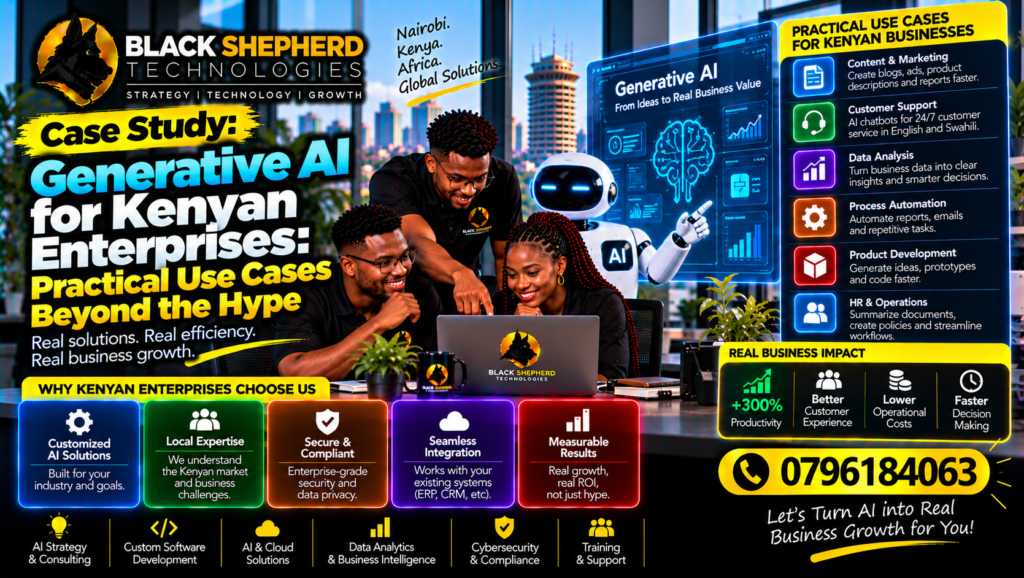
Over the past few years, artificial intelligence has dominated boardroom discussions, technology conferences, and corporate strategy sessions across Kenya. From Nairobi’s bustling commercial districts in Westlands and Upper Hill to expanding industrial operations, retail networks, and logistics hubs in Mombasa, Kisumu, Nakuru, and Eldoret, executives are keenly aware of the technological shift underway. However, for many business leaders, a significant gap remains between global tech hype and practical, ROI-driven local execution.
Early enterprise engagements with generative AI often began with simple experiments—such as utilizing generic conversational interfaces to draft basic emails or generate marketing copy. While these surface-level applications demonstrated capability, they barely scratched the surface of what artificial intelligence can achieve when deeply integrated into enterprise workflows. Today, forward-thinking Kenyan enterprises are moving past generic chatbots and superficial experiments. They are deploying custom, fine-tuned generative AI solutions that directly address localized operational bottlenecks, streamline multi-lingual customer communications, automate complex document processing, and integrate natively with regional financial infrastructure like Safaricom’s M-Pesa.
In a competitive economic environment where operating margins are constantly pressured by rising overheads, fluctuating exchange rates, and changing regulatory demands, generative AI represents far more than an innovative luxury. When deployed strategically, it operates as a high-performance multiplier for corporate productivity, customer retention, and operational efficiency.
At Black Shepherd Technologies, we design, engineer, and deploy custom software architectures, enterprise web applications, and intelligent AI automation suites tailored specifically for the East African economic environment. If you are assessing your enterprise digital roadmap or seeking to build practical AI capabilities, explore our professional engineering portfolio and projects to see how we bring market-leading technology solutions to life.
In this exhaustive, 3,000-word strategic guide, we will cut through the noise and explore the practical, enterprise-grade applications of generative AI in Kenya—covering localized language models, automated back-office workflows, financial integrations, regulatory compliance, and a clear implementation framework for sustainable enterprise growth.
-
Moving Beyond the Global Hype: What Generative AI Means for Kenya
To evaluate the true business value of generative AI, corporate leadership must first distinguish between generic overseas AI tools and enterprise-grade, localized solutions.
The Problem with Off-the-Shelf Global AI Models
Generic global AI platforms are trained on broad, publicly available datasets that reflect Western consumer behavior, regulatory environments, and business processes. When deployed directly into a Kenyan enterprise without custom fine-tuning or localized architecture, off-the-shelf tools frequently encounter severe operational limits:
-
Cultural and Linguistic Disconnect: Global models lack understanding of local linguistic nuances, including regional Swahili phrasing, local business idioms, and Sheng slang commonly used in everyday commercial communications.
-
Lack of Real-Time Internal Context: A public AI model knows nothing about your specific product catalogs, real-time warehouse inventory, internal Standard Operating Procedures (SOPs), or dynamic pricing tiers.
-
Integration Isolation: Generic tools operate in a vacuum. They cannot trigger automated M-Pesa STK Push prompts, query your central ERP database, or update order statuses in your local CRM without specialized middleware.
                    GENERIC AI VS. LOCALIZED ENTERPRISE AI

  FEATURE                    GENERIC GLOBAL AI TOOLS            CUSTOM ENTERPRISE AI SOLUTIONS
  -------------------------  ---------------------------------  -----------------------------------
  Language & Tone            Standard English                   English, Swahili & Sheng
  Business Context           Public Internet Data               Proprietary Enterprise Data (RAG)
  Integration Capability     Isolated Chat Interface            Native APIs (M-Pesa, ERP, CRM)
  Data Privacy & Control     Public Cloud Hosting               Sovereign Encryption & ODPC Rules
  Action Execution           Text Generation Only               Autonomous Multi-Step Workflows
What Defines Enterprise-Grade Generative AI?
Practical generative AI for Kenyan enterprises combines advanced Large Language Models (LLMs) with Retrieval-Augmented Generation (RAG), custom prompt engineering, and secure API microservices.
By anchoring the AI’s intelligence directly to your company’s internal databases, policy documents, and operational rules, the system acts as a specialized digital employee. It delivers mathematically accurate answers, respects company policies, and executes complex, multi-step actions autonomously across your existing software ecosystem.
Whether your organization operates in retail e-commerce, banking and micro-finance, logistics, healthcare, or professional services, grounding artificial intelligence in your specific business logic is critical. Explore our specialized industries we serve page to see how we build bespoke digital platforms tailored to diverse commercial sectors.
-
Five High-Impact Practical Use Cases for Kenyan Enterprises
Kenyan enterprises achieving measurable financial returns from generative AI are deploying technology into five primary operational areas:
                  5 PRACTICAL ENTERPRISE USE CASES

  1. Multilingual Conversational Commerce ---> 24/7 sales in Swahili, English & Sheng on WhatsApp.
  2. Intelligent Document Processing      ---> Automated OCR & parsing of invoices, contracts & PDFs.
  3. Context-Aware Knowledge Engines      ---> Instant internal search across SOPs & policy docs.
  4. Automated M-Pesa & Financial Support  ---> Real-time payment guidance & transaction lookups.
  5. Personalized Marketing & B2B Copy    ---> Hyper-localized campaign content at scale.
Use Case #1: Multilingual Conversational Commerce (WhatsApp & Web)
In East Africa, digital commerce is mobile-first and deeply conversational. Consumers prefer communicating directly via WhatsApp, social media messaging, and live website chat widgets rather than filling out static web forms.
Practical Enterprise Implementation:
-
Deploying fine-tuned generative AI sales agents connected directly to the official Meta Cloud API for WhatsApp Business and website chat.
-
Cultural Fluency: The AI agent converses fluidly in English, Swahili, and Sheng—answering complex customer questions, recommending relevant products from the central catalog, and explaining delivery terms to upcountry towns like Kisumu, Eldoret, or Nakuru.
-
Instant Checkout Execution: When the buyer commits to purchase, the AI agent collects delivery details and triggers an automated M-Pesa STK Push prompt directly to their mobile phone screen, creating a seamless, friction-free buying experience.
Use Case #2: Intelligent Document Processing (IDP) and Contract Analytics
Corporate legal, finance, and procurement departments spend thousands of hours manually reviewing supplier contracts, processing physical delivery notes, and rekeying invoice data into central accounting databases.
Practical Enterprise Implementation:
-
Utilizing generative AI combined with Optical Character Recognition (OCR) to parse unstructured documents—such as multi-page PDF agreements, supplier invoices, import bill of ladings, and tax receipts.
-
The system extracts critical data points (vendor tax PINs, payment terms, line-item totals, and expiration dates) with high precision, cross-checks calculations, flags non-compliant clauses for legal review, and populates your ERP automatically.
Use Case #3: Internal Enterprise Knowledge Engines (RAG Architecture)
In large organizations, valuable institutional knowledge remains trapped inside scattered PDF manuals, employee handbooks, policy documents, and legacy file servers. Employees waste valuable time asking managers or searching through folder structures to find basic operational answers.
Practical Enterprise Implementation:
-
Building a secure, internal generative AI knowledge assistant trained strictly on your organization’s proprietary documentation using Retrieval-Augmented Generation (RAG).
-
Instant Staff Guidance: Operations, HR, and customer support staff can ask the internal AI assistant questions in natural language: “What is our policy for processing returned goods from regional distributors?” or “What are the credit approval limits for tier-2 corporate clients?”
-
The AI retrieves the exact policy clause instantly, citing the source document and page number, ensuring brand-wide compliance and drastically reducing internal training cycles.
Use Case #4: Automated Financial Guidance and M-Pesa Reconciliation Support
Managing customer billing inquiries, payment receipts, and invoice status updates manually places a heavy burden on finance and support teams.
Practical Enterprise Implementation:
-
Integrating generative AI assistants with backend financial ledgers and Safaricom’s Daraja API endpoints.
-
When a customer queries their account status via WhatsApp or web portal, the AI checks real-time database records securely: “Habari Brian, tumepokea malipo yako ya KES 15,000 kupitia M-Pesa (Receipt #QKH789XYZ10). Balance yako iliyosalia ni KES 0. Order yako iko kwa dispatch.”
-
Answering payment queries autonomously eliminates thousands of routine support calls and accelerates cash flow collection cycles.
Use Case #5: Hyper-Localized Content Generation and B2B Personalization
Marketing and corporate communications teams must continuously generate fresh, relevant content across social channels, email newsletters, B2B sales proposals, and product catalogs.
Practical Enterprise Implementation:
-
Utilizing custom-prompted generative AI pipelines to create hyper-localized marketing copy, product descriptions, and personalized B2B sales proposals tailored to specific market segments across East Africa.
-
The AI adapts tone, terminology, and messaging to match specific regional demographics while maintaining strict alignment with corporate brand guidelines.
-
Technical Architecture: How to Build Secure Enterprise AI Pipelines
To deploy production-grade generative AI without exposing your business to hallucination risks, system crashes, or data leaks, enterprises must adopt a structured, secure technical architecture.
               ENTERPRISE GENERATIVE AI ARCHITECTURE

 [ DATA SOURCES ]           [ MIDDLEWARE / RAG CORE ]        [ AI INFERENCE & APIS ]
 - Enterprise ERP/CRM  -->  - Vector Database (Pinecone) -->  - Fine-Tuned LLM Engine
 - Internal Policy PDFs     - Document Chunking Pipeline      - Guardrails & Safety Filter
 - Product Catalogs         - Semantic Search Retriever       - REST API / Webhook Router
The Three Core Layers of Enterprise AI
-
The Ingestion and Vectorization Layer:
-
Enterprise documents, product databases, and customer policies are broken down into structured text chunks.
-
These chunks are processed through embedding models and stored in high-performance Vector Databases (such as Pinecone, Qdrant, or Pgvector). Vector databases allow the AI to perform “semantic search”—finding relevant business information based on meaning rather than basic keyword matching.
-
-
The Retrieval-Augmented Generation (RAG) Middleware:
-
When a user submits a query, the RAG middleware searches the vector database first to retrieve the exact internal business context related to the question.
-
The middleware packages this verified internal context together with the user’s question and passes it to the Large Language Model.
-
This guarantees that the AI answers strictly using your verified company facts, completely eliminating false statements or “hallucination” errors.
-
-
Enterprise Guardrails and API Routing:
-
Content Safety & Boundary Filters: Rules prevent the AI from discussing off-topic subjects, offering unauthorized discounts, or disclosing sensitive corporate data.
-
API Orchestration: The AI layer communicates via secure REST APIs with external platforms (Safaricom Daraja API, Meta Cloud WhatsApp API, internal ERPs), executing real-time data lookups and automated actions.
-
-
Addressing Data Privacy, Security, and Compliance in Kenya
Deploying generative AI within an enterprise environment introduces critical legal and regulatory responsibilities that executive leadership must navigate carefully.
1. Compliance with the Data Protection Act
In Kenya, processing personal customer records, financial histories, or employee data is regulated under the Data Protection Act and overseen by the Office of the Data Protection Commissioner (ODPC).
-
Zero Public Data Training: Ensure your enterprise AI architecture explicitly prevents public AI vendors from using your proprietary corporate data or customer interactions to train their public models.
-
Explicit User Consent: Disclose clearly to customers when they are interacting with an automated AI system, obtaining proper consent for data processing.
-
Data Anonymization: PII (Personally Identifiable Information) such as national ID numbers, phone numbers, and physical addresses should be anonymized or masked before passing text to external AI processing pipelines.
2. Role-Based Access Controls (RBAC) and Governance
Not all employees or external users should have access to the same corporate information via an AI assistant:
-
Granular Permission Structures: An internal HR AI assistant must verify user authentication levels before disclosing executive salary bands or confidential performance reviews.
-
Comprehensive Audit Logging: Maintain detailed system logs recording every user prompt, AI response, and background API action for internal compliance audits.
-
Step-by-Step Implementation Roadmap for Enterprise Leaders
Successfully integrating generative AI into your business requires a phased, risk-managed rollout strategy:
                  ENTERPRISE AI IMPLEMENTATION ROADMAP

  [ PHASE 1 ]   --->   [ PHASE 2 ]   --->   [ PHASE 3 ]   --->   [ PHASE 4 ]
  Use Case Audit       Data Prep &          Pilot Testing &       Production Scale
  & ROI Scoping        RAG Architecture     Human Supervision     & Continuous Tuning
Phase 1: High-ROI Use Case Identification
-
Avoid trying to automate every department simultaneously. Select one or two high-friction operational areas with structured data and clear metrics (e.g., tier-1 WhatsApp support deflection or supplier invoice parsing).
-
Define clear success metrics: Target response speeds, accuracy rates, deflection percentages, and saved labor hours.
Phase 2: Data Sanitation and RAG Infrastructure Setup
-
Clean, update, and organize your company’s internal documentation, product catalogs, and Standard Operating Procedures.
-
Partner with experienced software engineers to deploy a secure vector database, vectorization pipeline, and RAG middleware.
Phase 3: Pilot Rollout with Human-in-the-Loop Supervision
-
Deploy the AI solution to a controlled pilot group (e.g., internal staff or 10% of incoming customer traffic).
-
Implement “human-in-the-loop” escalation protocols: If the AI encounters a complex query or low-confidence score, it hands the conversation off smoothly to a human team member with full conversation context attached.
Phase 4: Production Scaling and Continuous Model Tuning
-
Expand the AI deployment across all target customer or operational channels.
-
Review conversation logs and analytical performance dashboards weekly, continually refining prompt instructions and updating vector databases as your business policies evolve.
-
Driving Enterprise Visibility and Growth with Advanced SEO
Deploying practical generative AI solutions across your internal operations and customer touchpoints ensures that when buyers interact with your business, they experience immediate engagement, personalized assistance, and frictionless transaction execution. However, internal efficiency and modern technology represent only one side of the commercial growth equation; your enterprise must also capture continuous market demand.
If prospective corporate clients, B2B buyers, or retail consumers searching for your products and services online cannot discover your digital platform on Google, your competitors will capture that market share. Implementing technical SEO, structured schema markup, fast page speed optimization, and targeted local content strategies is essential for dominating search engine results pages. Partnering with professionals providing expert SEO services in Kenya is the most sustainable way to drive high-value organic traffic directly to your digital ecosystem.
Conclusion: Moving from AI Hype to Real Commercial Value
The era of viewing generative AI as a novel experiment or superficial marketing tool is over. For growing businesses across Kenya and East Africa, artificial intelligence represents practical, high-value infrastructure capable of eliminating administrative friction, automating complex document workflows, providing 24/7 multilingual sales support, and driving sustainable profitability.
By moving beyond generic overseas tools, anchoring AI capabilities in verified corporate data, and executing native integrations with regional payment rails like M-Pesa, enterprise leaders can transform routine operations into a formidable competitive advantage.
At Black Shepherd Technologies, we empower corporate enterprises, retail networks, financial institutions, and growing businesses across East Africa with elite custom software engineering, robust RAG architectures, and intelligent AI automation workflows. Get in touch with our engineering team today to audit your current digital stack, explore practical AI use cases, and build a modern enterprise foundation engineered for market leadership and sustainable growth.
