
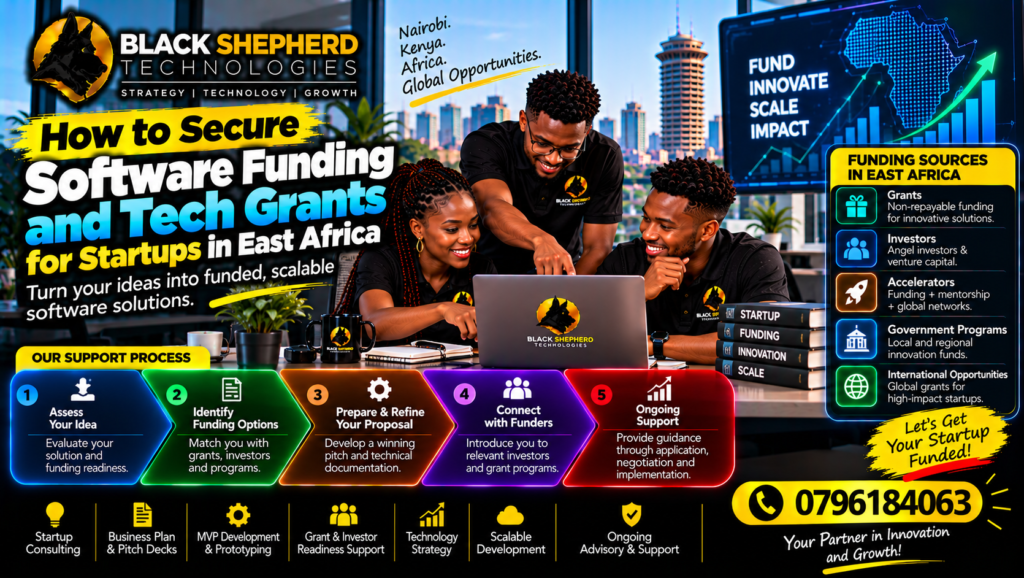
The tech and innovation ecosystem across East Africa—anchored by Nairobi’s world-famous Silicon Savannah and rapidly expanding across Kigali, Kampala, and Dar es Salaam—has established itself as one of the most vibrant investment destinations on the African continent. Across fintech, healthtech, agritech, logistics, and clean energy, visionary founders are building transformative software solutions to address regional challenges.
However, for early-stage founders and growing technology ventures, the journey from initial software concept to market launch and sustainable scale is paved with financial hurdles. Building enterprise-grade mobile applications, engineering custom software architectures, and scaling cloud infrastructure require substantial capital. Navigating the complex funding landscape—spanning non-dilutive technology grants, impact investment funds, angel investor networks, and venture capital—demands a clear strategy, compelling technical validation, and flawless preparation.
Securing non-dilutive software grants and venture funding is not merely a matter of submitting pitch decks or filling out online application forms. Investor and donor communities evaluate technical architecture, team capability, local market fit, financial governance, and scalable digital infrastructure.
At Black Shepherd Technologies, we engineer high-performance software, custom web applications, and scalable digital platforms tailored specifically for the East African economic ecosystem. If you are preparing your technology roadmap for investment or looking to demonstrate technical execution to funders, explore our professional engineering portfolio and projects to see how we build market-leading software platforms.
In this exhaustive, 3,000-word capital-raising guide, we will break down the end-to-end framework for securing software funding and tech grants in East Africa, covering funding categories, application strategies, technical due diligence preparation, and investor pitch alignment.
-
The Funding Landscape in East Africa: Understanding Capital Channels
To successfully secure capital for your software startup, executive leadership must first understand the distinct funding avenues available across the East African regional hub and align their capital strategy with the appropriate vehicle.
A. Non-Dilutive Technology Grants and Innovation Funds
Grant funding is the holy grail for early-stage software startups because it provides non-dilutive capital—meaning you do not give up equity or ownership control of your company in exchange for funding.
-
Key Funders: Global development agencies (such as USAID, GIZ, FSD Kenya), philanthropic foundations (Gates Foundation, Rockefeller Foundation), regional innovation hubs, and corporate grant programs (such as GSMA Innovation Fund, Google for Startups Accelerator Africa, and Tony Elumelu Foundation).
-
Primary Focus: Grants are overwhelmingly thesis-driven. Funders prioritize software solutions delivering measurable social impact, financial inclusion, gender lens investing, agricultural supply chain efficiency, climate resilience, or healthcare access across East Africa.
B. Venture Capital (VC) and Impact Investors
Venture capital firms invest capital in exchange for equity ownership, seeking high-growth software ventures capable of delivering exponential financial returns.
-
Key Funders: Active regional and international VCs operating in East Africa, including Novastar Ventures, Partech Africa, Lateral Frontiers, CRE Venture Capital, Saviu Ventures, and local impact funds like Chandaria Capital.
-
Primary Focus: Commercial scalability, high gross margins, defensible technology moats, large total addressable markets (TAM), and rapid user retention and revenue acquisition metrics.
C. Angel Networks and High-Net-Worth Individuals (HNWIs)
Angel investor networks pool capital from experienced business leaders, corporate executives, and successful entrepreneurs to back early-stage ventures.
-
Key Networks: Nairobi Angels Network (NAN), Victoria Ventures Academy, and regional angel syndicates across Kampala and Kigali.
-
Primary Focus: Strong founder-market fit, clear early technical traction (such as a working MVP), and immediate commercial viability within regional commercial sectors.
Whether your software platform targets retail e-commerce, agricultural supply chains, financial services, or healthcare logistics, tailoring your value proposition to match specific funder mandates is critical. Explore our specialized industries we serve page to see how we build software solutions tailored to diverse commercial sectors.
-
Preparing Your Startup for Technical Due Diligence
One of the primary reasons early-stage technology startups in East Africa fail during grant evaluations or investment due diligence is the lack of a robust, scalable, and secure technical foundation. Investors and grant committees do not fund mere pitch decks; they fund technical execution capability and defensible intellectual property.
            THE TECH FUNDING READINESS PIPELINE

 [ PROOF OF CONCEPT ]       --->  [ TECHNICAL DUE DILIGENCE ]    --->  [ CAPITAL ALLOCATION ]
 - Working MVP / Prototype         - Secure, clean codebase              - Equity funding / Grants
 - Validated user traction         - M-Pesa & API integration            - Growth acceleration
 - Scalable cloud roadmap          - Data Protection Act compliance      - Market expansion
1. Build a High-Performing Minimum Viable Product (MVP)
A PowerPoint deck describing a software concept is rarely enough to secure significant grant funding or VC backing today. Funders expect a functional, testable Minimum Viable Product (MVP) or working prototype that demonstrates core technical feasibility.
-
Clean UI/UX Architecture: Your software user interface must be intuitive, mobile-responsive, and optimized for local user behavior.
-
Core Functionality First: Focus on engineering the primary workflow that solves your target user’s pain point flawlessly rather than building dozens of half-finished features.
2. Demonstrate Localized API Integration & Interoperability
In East Africa, software solutions operating in isolation fail to achieve scale. Grant agencies and investors look for deep, seamless integration with regional digital ecosystems:
-
Safaricom M-Pesa Integration: Native integration with Safaricom’s Daraja API for automated STK push payment triggers, real-time webhook transaction confirmation, and B2C automated disbursements.
-
Cross-Border Payment Rails: Integration with regional payment gateways (Pesapal, IntaSend, Flutterwave) supporting multi-currency and card processing across Kenya, Uganda, Tanzania, and Rwanda.
-
Third-Party Systems: Native API connectors for logistics tracking, messaging rails (WhatsApp Business API, SMS gateways), and government compliance portals (such as KRA eTIMS).
3. Ensure Strict Compliance with Regional Data Privacy Laws
With the enforcement of the Kenya Data Protection Act and equivalent regional privacy frameworks, grant committees and impact investors conduct rigorous data governance reviews before approving software funding.
-
Data Encryption: End-to-end encryption for sensitive customer records, financial transactions, and personal identifiable information (PII) both at rest and in transit.
-
Role-Based Access Control (RBAC): Granular permission structures ensuring user data is accessed strictly on a need-to-know basis.
-
Data Residency Controls: Clear documentation showing where cloud servers are hosted and how cross-border data transfers are managed safely.
-
Step-by-Step Guide to Writing Winning Grant Applications
Securing non-dilutive tech grants requires a rigorous, methodical approach. Grant writing is a distinct discipline that combines technical accuracy, social impact metrics, and financial clarity.
Step 1: Align Your Software Narrative with Funder Mandates
Grant organizations operate with explicit thematic mandates—such as advancing financial inclusion for women micro-entrepreneurs, reducing post-harvest agricultural losses, or expanding solar pay-as-you-go access.
-
Do not attempt to force a generic software pitch into an unrelated grant call.
-
Expressly articulate how your software platform acts as the core technological enabler for the grant’s target social impact goals.
Step 2: Formulate Clear Theory of Change and Impact Metrics
Grant evaluation panels evaluate proposals using a structured “Theory of Change” framework:
-
Inputs: Funding capital, engineering talent, cloud infrastructure.
-
Activities: Software development, API integration, user onboarding, field testing.
-
Outputs: Number of active mobile app users, transactions processed, rural farmers connected.
-
Outcomes: Percentage increase in farmer household income, reduction in transaction fees, or time saved accessing healthcare.
Step 3: Present a Realistic Budget and Milestone Roadmap
Grant reviewers scrutinize project budgets to ensure financial realism and fiscal responsibility.
-
Itemize Software Development Costs: Break down engineering expenses clearly—distinguishing between core software architecture, UI/UX design, security audits, server hosting, and API maintenance.
-
Tie Disbursement to Milestones: Structure your project roadmap into clear, verifiable milestones (e.g., Milestone 1: Beta MVP release; Milestone 2: M-Pesa integration & pilot testing; Milestone 3: Scale to 5,000 active users).
-
Pitching Venture Capitalists: What East African VCs Look For
While grant committees focus heavily on social impact and thematic alignment, venture capital investors prioritize commercial scalability, rapid market adoption, financial returns, and exit potential.
Key Evaluation Pillars for VC Investors
-
Total Addressable Market (TAM): Can your software platform scale beyond a single local neighborhood or city to capture a regional market across East and Central Africa?
-
Defensible Technology Moat: What prevents a competitor from cloning your software application in six months? Proprietary machine learning algorithms, deep regional payment integrations, exclusive data partnerships, or strong network effects create defensible moats.
-
Unit Economics and Margins: Does your software generate high gross margins? Clearly articulate your customer acquisition cost (CAC), lifetime customer value (LTV), monthly recurring revenue (MRR), and churn rates.
-
Strong Technical Execution Team: Investors place immense weight on the capability of the founding team. Having experienced software architects, system engineers, and product managers who have built and deployed production-grade applications builds immediate investor confidence.
-
Common Pitfalls That Lead to Funding Rejections
Understanding why tech funding applications fail is as important as knowing what to include. Avoid these frequent mistakes that lead to immediate rejection:
-
Inadequate Financial Governance: Failing to maintain audited financial statements, clear corporate governance records, or proper business registration in recognized jurisdictions.
-
Over-Promising and Under-Delivering on Tech Timelines: Claiming your team can build a complex, multi-sided enterprise platform with custom AI features in two weeks signals a lack of software engineering reality to technical reviewers.
-
Ignoring the Local User Context: Designing software applications that require high-end smartphones or constant high-speed fiber internet, ignoring the reality of budget Android devices and intermittent cellular connectivity common in rural market segments.
-
Weak Intellectual Property Protection: Failing to execute clear, legally binding IP assignment contracts with external software developers, leaving source code ownership in legal jeopardy.
-
Driving Post-Funding Growth with Enterprise SEO
Securing software funding or a major technology grant is a monumental achievement, but capital is simply the fuel to accelerate growth. Once your software platform or web application is launched, you must drive continuous user acquisition, customer retention, and brand visibility.
If prospective business clients, retail users, or future follow-on investors searching for your solutions online cannot find your web application or platform on Google, your competitors will capture that market share. Implementing technical SEO, structured schema markup, fast page speed optimization, and targeted local content strategies is essential for dominating search engine results. Partnering with professionals providing expert SEO services in Kenya is the most sustainable way to drive high-value organic traffic directly to your digital ecosystem.
Conclusion: Turning Your Technology Vision into Funded Reality
Securing software funding and tech grants in East Africa is a structured journey that demands strategic alignment, financial discipline, clear social and commercial impact metrics, and, above all, uncompromising software execution.
By building functional Minimum Viable Products, engineering native integrations with regional financial ecosystem rails like M-Pesa, ensuring strict data privacy compliance, and presenting clear technical roadmaps, founders can stand out in competitive funding pipelines and secure the capital needed to scale.
At Black Shepherd Technologies, we partner with visionary entrepreneurs, growing enterprises, and funded ventures across East Africa to engineer elite custom software, mobile applications, and high-performance digital architectures. Get in touch with our engineering team today to build a production-grade software foundation that satisfies rigorous investor due diligence and drives sustainable business growth.
