
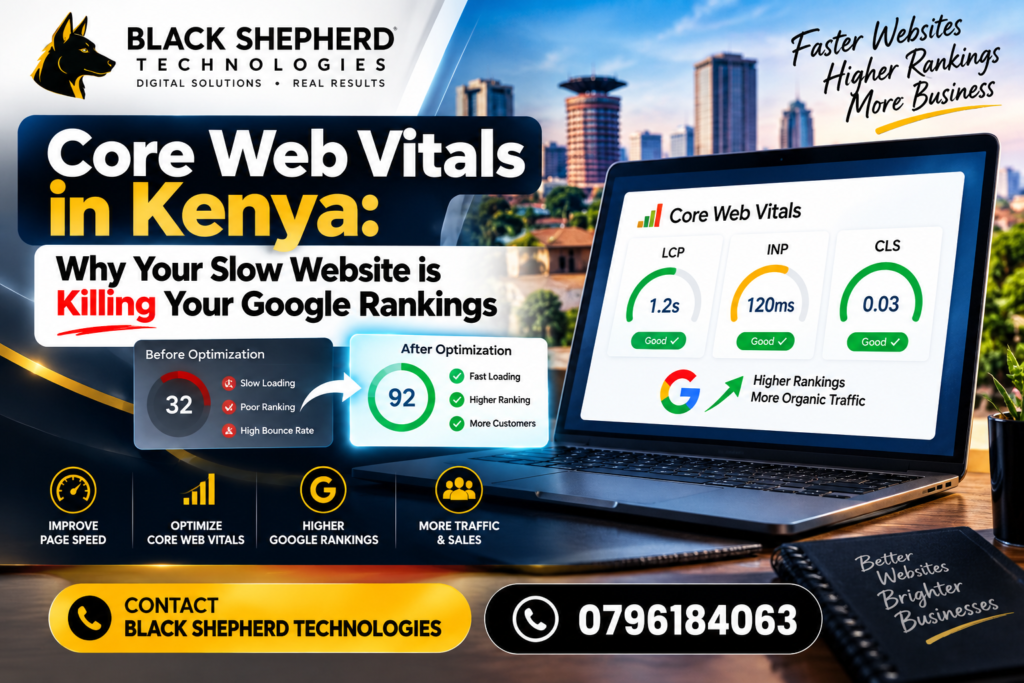
In the bustling digital marketplace of Nairobi and across Kenya, business owners are investing heavily in online visibility. You spend countless hours brainstorming content, paying for Google Ads, posting on TikTok, and polishing your brand identity. Yet, despite having a brilliant product or service, your website lingers on page three of Google Search results, struggling to pull in organic traffic.
If your bounce rates are climbing and conversions are flatlining, look closer at the hood of your website. The culprit isn’t always your keyword strategy or your backlink profile—it’s performance.
Google’s search algorithm has evolved far beyond simple keyword matching. Today, user experience metrics known as Core Web Vitals dictate who wins the top spots on Search Engine Results Pages (SERPs) and who gets buried. In a mobile-first market like Kenya, where internet speeds vary from high-speed fiber in Westlands to erratic mobile data connections in regional towns, ignoring these technical performance metrics is nothing short of business suicide.
This comprehensive guide explores Core Web Vitals, how they impact your digital footprint in Kenya, why a slow website destroys your search rankings, and how partnering with experts specializing in SEO services in Kenya can transform your slow site into a high-converting digital powerhouse.
1. What Are Core Web Vitals? (And Why Google Cares)
Core Web Vitals are a subset of Google’s broader “Page Experience” signals. They are standardized metrics that measure real-world user experience for web pages—specifically focusing on loading performance, visual stability, and interactivity.
Google wants to deliver the best possible experience to its users. If a user clicks on your link from a search result in Mombasa or Kisumu, and your homepage takes eight seconds to render while jumping up and down as images load, that user will bounce back to Google. Google tracks this frustration. Over time, poor user signals translate directly into lower rankings.
The three pillars of Core Web Vitals are:
1. Largest Contentful Paint (LCP)
LCP measures loading performance. To provide a good user experience, LCP should occur within 2.5 seconds of when the page first starts loading. The “largest content element” is typically a hero image, a large heading, or a heavy background video on your landing page. If your LCP is sluggish, your visitors stare at a blank screen, wondering if your site is broken.
2. Interaction to Next Paint (INP)
Replaced the older First Input Delay (FID) metric in March 2024, INP measures responsiveness. It assesses all clicks, taps, and keyboard interactions a user makes with your page throughout its lifecycle, returning the worst-case latency. A good INP score is 200 milliseconds or less. If a Kenyan shopper taps “Add to Cart” or “Book Consultation” on their smartphone and the site freezes for a second before responding, your INP is failing.
3. Cumulative Layout Shift (CLS)
CLS measures visual stability. Have you ever tried to click a button on a news portal or e-commerce site, only for an ad or image to load at the last second, causing you to click the wrong link instead? That annoying shift is layout instability. A good CLS score is less than 0.1.
2. The Kenyan Context: Why Core Web Vitals Matter Locally
Running a website in Kenya presents unique technical and infrastructural realities that global web templates often ignore.
The Mobile-First Reality
The vast majority of web traffic in Kenya originates from mobile devices—smartphones connecting via Safaricom, Airtel, or Telkom networks. While 4G and expanding 5G coverage are robust in urban centers like Nairobi, Nakuru, and Eldoret, many users browse on mid-range or budget smartphones with limited processing power. Furthermore, signal drops and fluctuating bandwidth are common realities during commutes or while indoors.
When your website is bloated with unoptimized plugins, heavy high-resolution media files, and messy JavaScript, it might load in two seconds on a developer’s high-end fiber-connected MacBook Pro in Kilimani. However, that same site can easily take 12 to 15 seconds to load on a budget Android device running on a 3G/4G mobile network in a bustling commercial hub.
The Cost of Data
Internet data in Kenya is a valued commodity. Users are acutely aware of data consumption. When a poorly coded website forces a browser to download 8 megabytes of uncompressed images and bloated tracking scripts just to show a simple text-based service page, users feel the pinch—and they abandon the site immediately.
When visitors bounce within three seconds, dwell time drops, bounce rates spike, and Google’s automated crawlers register your page as low quality. No amount of keyword stuffing can save a site that fundamentally wastes a user’s time and data.
3. How a Slow Website Kills Your Google Rankings
Google’s algorithm views the web through the eyes of the end user. If user metrics signal frustration, your rankings suffer a cascading failure. Here is how a slow website actively dismantles your SEO strategy:
A. The Direct Algorithmic Penalty
Since the rollout of the Page Experience update, Core Web Vitals have been an official ranking factor. While high-quality content remains paramount, two competing websites with equally good content will see the faster, more stable site take the top spot on SERPs. If your competitors pass their Core Web Vitals audits and you fail yours, you are handing them the top positions on a silver platter.
B. Crawl Budget Depletion
Search engine crawlers (like Googlebot) have a finite amount of resources allocated to crawl your website—known as crawl budget. If your server response time is slow and your pages take an eternity to render due to unoptimized code and database bloat, Googlebot burns through its allocated time downloading just a handful of heavy pages. Consequently, newer blog posts, product updates, or service pages take weeks to get indexed, leaving your digital marketing campaigns stalled.
C. Exploding Bounce Rates and Dwell Time Collapse
User behavior metrics are baked into modern search rankings. When a user lands on your site and faces a sluggish loading screen, they click the “Back” button instantly. This action signals to Google that your page did not satisfy the user’s search intent. As bounce rates climb and dwell times plummet, Google systematically demotes your URL in favor of faster alternatives.
D. Conversion Killers: Traffic Without Revenue
Getting ranked is only half the battle; the ultimate goal of SEO is conversion—generating leads, inquiries, and sales. Even if you manage to rank decently with a slow website, your conversion rates will suffer immensely.
Whether you operate across diverse commercial sectors—from hospitality and real estate to manufacturing and retail—frictionless user experiences dictate buyer trust. A slow checkout page, a lagging contact form, or a jumpy catalog grid destroys consumer confidence. Buyers in Kenya have endless options; they will not wait for a broken digital experience when a competitor’s site loads instantly.
4. Common Culprits Behind Slow Kenyan Websites
Why are so many business websites in Kenya struggling with Core Web Vitals? The root causes usually stem from poor development practices, cheap shared hosting, and an over-reliance on unoptimized content management systems.
1. Cheap, Overseas Shared Hosting
Many businesses cut corners by purchasing the cheapest shared hosting packages available from foreign providers with data servers located in the US or Europe. The physical distance (latency) alone adds hundreds of milliseconds to your Time to First Byte (TTFB). Compounded by overcrowded server nodes running outdated PHP versions, your website stutters before it even begins rendering content.
2. Bloated WordPress and WooCommerce Setups
While WordPress is an exceptional CMS, it is frequently abused. Agencies or DIY creators stack dozens of heavy plugins—page builders, sliders, popup generators, social proof widgets, and analytics scripts—onto a single site. Each plugin injects its own CSS and JavaScript stylesheets into the header, choking browser rendering engines and tanking both LCP and INP scores.
3. Unoptimized Media Assets
High-definition product photos, uncompressed banner images, and embedded YouTube videos loaded directly on the homepage are primary drivers of massive LCP failures. Uploading a 4MB PNG file straight from a smartphone or digital camera directly to a website without compression or conversion to modern formats like WebP or AVIF guarantees a failed Core Web Vitals audit.
4. Excessive Third-Party Scripts
Every tracking pixel (Facebook, TikTok, Google Analytics, Hotjar), live chat widget, and Google Font loaded from external servers forces the browser to open multiple external connections. While these tools are essential for digital marketing, unmanaged third-party scripts block the main thread, causing severe interactivity delays (poor INP).
5. Proven Strategies to Fix Core Web Vitals and Dominate SERPs
Fixing Core Web Vitals requires a mix of technical engineering, infrastructure upgrades, and disciplined content management. Here is how elite developers and SEO strategists overhaul web performance:
Step 1: Upgrade to Local or Optimized CDN Hosting
Move away from sluggish, overcrowded overseas shared servers. Invest in high-performance cloud hosting or VPS configurations optimized for speed. Furthermore, leveraging a robust Content Delivery Network (CDN) like Cloudflare caches static assets across edge servers globally and regionally, ensuring that a user in Nairobi, Mombasa, or Kisumu downloads site assets from the nearest geographical node.
Step 2: Ruthlessly Audit and Streamline Your Tech Stack
Conduct a thorough audit of all installed plugins, scripts, and themes. Remove redundant plugins, replace heavy page builders with lightweight alternatives or custom HTML/CSS code architectures, and defer non-essential JavaScript.
Step 3: Modernize Image and Media Handling
Implement automated image compression and serve images in next-gen formats (WebP and AVIF) with explicit width and height attributes defined in your HTML. This single step prevents layout shifts (CLS) and drastically shrinks page weight, accelerating your Largest Contentful Paint.
Step 4: Implement Advanced Static Site Architecture
For many informational, portfolio, and corporate websites, dynamic database queries for every single page load are unnecessary overhead. Transitioning dynamic WordPress architectures into lightning-fast static HTML setups, combined with LiteSpeed caching and edge optimization, completely eliminates database lag and delivers instantaneous page loads.
To see how advanced engineering translates into digital success, explore successful digital projects and case studies that highlight dramatic speed and ranking transformations.
6. Case Study: The Transformation of a Nairobi E-Commerce Brand
Consider a mid-sized retail client based in Nairobi that approached Black Shepherd Technologies with a frustrating problem: despite having a massive catalog of trending products and a healthy budget pumped into digital advertising, online sales were stagnant and organic search traffic had plateaued.
An initial technical audit revealed shocking metrics:
-
Mobile LCP: 7.4 seconds ( failing)
-
INP: 450 ms ( failing)
-
CLS: 0.28 ( failing)
-
Average Server Response Time: 1.8 seconds
The website was running an overloaded WooCommerce theme packed with 52 active plugins, uncompressed product imagery, and an unoptimized overseas hosting plan. Every time a user searched for a product on mobile, the site stalled.
The Intervention Strategy
Our engineering and SEO team executed a comprehensive performance overhaul:
-
Infrastructure Migration: Migrated the site from a budget shared host to an optimized cloud server paired with Cloudflare Enterprise CDN.
-
Code Stripping & Custom Optimization: Removed 35 unnecessary plugins, refactored the frontend theme into a lean custom build, and eliminated render-blocking JavaScript.
-
Asset Modernization: Automated the conversion of all product photos into compressed WebP formats and implemented lazy loading for offscreen assets.
-
Database Cleanup: Cleaned up transient database tables, optimized query structures, and implemented advanced LiteSpeed caching rules.
The Results After 60 Days
Within two months of launching the optimized site:
-
Mobile LCP dropped to 1.6 seconds (Passing).
-
INP improved to 110 ms (Passing).
-
CLS dropped to 0.02 (Passing).
-
Organic Search Traffic surged by 142%.
-
Mobile Conversion Rates increased by 68%, translating to a massive jump in monthly revenue.
This turnaround underscores a fundamental truth: web performance is not just a technical metric for developers to obsess over; it is a direct driver of business revenue.
7. The Blueprint for Long-Term Digital Success in Kenya
Achieving stellar Core Web Vitals is not a one-time fix. As you add new blog posts, update product catalogs, and integrate new marketing pixels, performance can gradually degrade if not continuously monitored.
To maintain your competitive edge in Kenya’s fast-paced digital ecosystem, adopt a continuous optimization mindset:
-
Regular Audits: Use tools like Google PageSpeed Insights, GTmetrix, and Google Search Console’s Core Web Vitals report monthly to catch regressions early.
-
Prioritize Mobile Testing: Always test your site performance on real mobile devices under throttled network conditions rather than relying solely on desktop simulations.
-
Partner with Specialists: Technical SEO and web performance engineering require specialized expertise. Collaborating with seasoned professionals ensures your digital assets comply with evolving search algorithms without compromising aesthetic appeal or functional depth.
Conclusion
Your website is your 24/7 digital storefront. If visitors walk up to your door and encounter a sluggish, unresponsive, and jumpy experience, they will walk away—and Google will notice. Ignoring Core Web Vitals in 2026 means gifting your hard-earned market share to competitors who understand that speed, stability, and seamless interactivity are non-negotiable pillars of modern online success.
Don’t let a slow website kill your Google rankings and drain your marketing budget. Whether you need a complete infrastructure overhaul, lightning-fast web engineering, or comprehensive growth strategies, expert technical support is within reach.
Ready to transform your digital presence, crush your competition on search engines, and convert casual browsers into loyal customers? Discover how specialized SEO services in Kenya can elevate your brand today. Explore our proven portfolio and project case studies or find tailored solutions designed for your specific business sector across industries we serve. Take control of your website’s performance and claim the top spot you deserve.
