
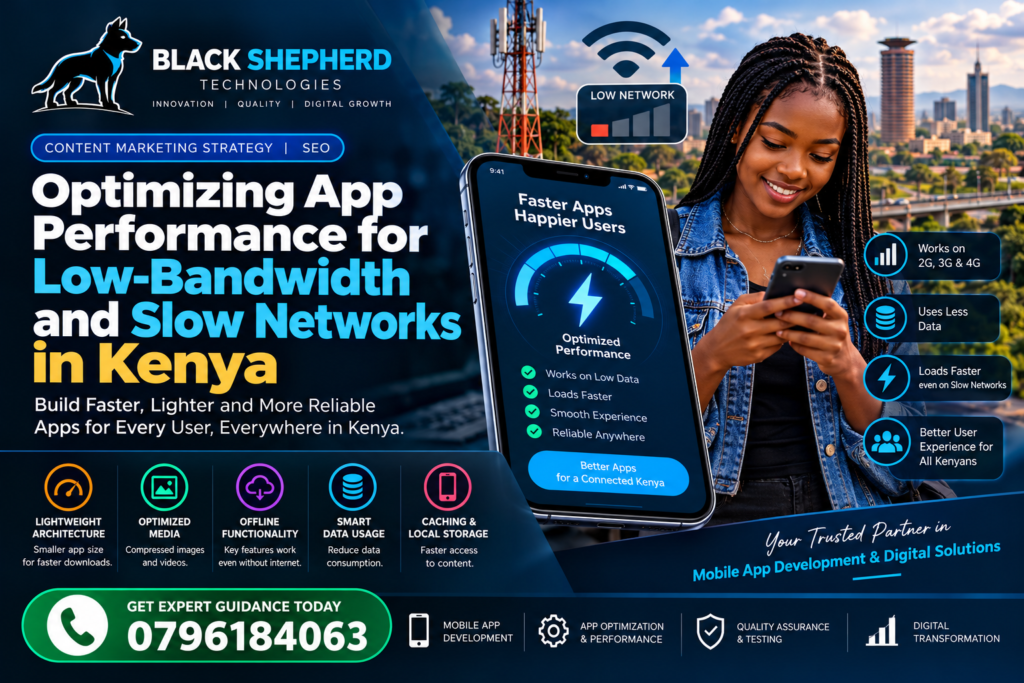
The digital landscape across Kenya—thriving from the bustling tech corridors of Nairobi’s Kilimani and Westlands to dynamic county centers across the nation—is undeniably mobile-first. Millions of citizens rely on mobile applications daily to transact via M-Pesa, manage businesses, access healthcare, shop online, and navigate logistics.
Yet, anyone who has ever traveled on a commuter matatu along Thika Road, stepped inside a heavy concrete commercial building, or traveled across regional county boundaries knows a fundamental truth: network connectivity in Kenya is not uniform.
While major urban centers boast high-speed 4G and expanding 5G coverage, mobile data reliability, latency, and throughput fluctuate dramatically. Furthermore, for the everyday consumer, mobile data bundles represent a conscious, calculated monthly household expense.
Despite these economic and infrastructure realities, a staggering number of mobile apps are designed and tested under pristine, high-speed office fiber or 5G Wi-Fi conditions. When these resource-heavy apps are deployed into the hands of real users facing spotty 3G or constrained bandwidth, they stutter, throw endless loading spinners, consume excessive data, and are uninstalled within seconds.
If you are a startup founder, product manager, or software engineer building products for the Kenyan market, optimizing your mobile app for low-bandwidth and slow networks is not an optional nice-to-have feature—it is the ultimate dividing line between commercial success and instant abandonment.
This comprehensive guide explores why network optimization matters, how to diagnose bandwidth bottlenecks, and proven technical strategies to build lightning-fast, data-efficient mobile applications in Kenya.
Part 1: The Realities of Network Connectivity in Kenya
To build an app that performs brilliantly under constrained conditions, you must first understand the ground-level realities of how mobile networks operate in Kenya.
1. The Spectrum of Connectivity
- Urban High-Speed Zones: Areas like central Nairobi, major tech hubs, and high-end residential estates enjoy robust 4G and growing 5G connections. Developers working in these offices often experience zero latency.
- The Edge and Rural Realities: As users move into commercial basements, high-density multi-story residential blocks, or rural county regions, signal strength drops precipitously. Networks frequently degrade from 4G down to congested 3G or intermittent Edge connections.
2. The Psychology of Data Economy
In Kenya, data bundles are treated with careful economic consideration. Consumers monitor their gigabyte consumption closely.
- The Implication: An app that consumes 50 megabytes of background data silently while sitting idle in a user’s pocket is perceived as predatory and wasteful. Users will swiftly delete it to protect their data bundles.
- Loading Patience Threshold: Psychological studies show that mobile users abandon a loading screen after roughly 3 seconds of unresponsiveness. On a slow 3G network, an unoptimized app making ten sequential API calls will test a user’s patience within the first 10 seconds, leading to permanent churn.
Part 2: Core Principles of Low-Bandwidth App Optimization
Achieving blazing-fast performance on constrained networks requires an intentional shift in how your development team architects frontend layouts, handles data payloads, manages caching, and communicates with backend servers.
1. Minimize Payload Sizes and Network Requests
Every byte traveling across a cellular network consumes battery life and bandwidth. Reducing your app’s network footprint starts with leaner API payloads.
- Payload Stripping: Ensure your backend APIs only transmit the data fields required for the active screen. If a user is viewing a summarized list of products, do not return bloated JSON objects containing full descriptions, high-resolution image arrays, and deep historical logs. Implement pagination or lazy loading.
- Modern Data Serialization: Move away from bulky XML or uncompressed text formats where applicable. Utilize efficient binary serialization protocols (such as Protocol Buffers or optimized JSON structures) for high-frequency data streams.
2. Aggressive Asset Compression and Modern Formats
Images, icons, and media files are the primary culprits behind bloated app downloads and slow screen rendering times.
- Next-Gen Image Formats: Stop serving uncompressed PNG or JPEG files. Convert your static assets and user uploads into modern, highly compressed formats like WebP or AVIF, which deliver superior visual fidelity at a fraction of the file size.
- Resolution Scaling: Never serve a 4000×3000 pixel camera image directly into a thumbnail view that measures 100×100 pixels. Implement dynamic server-side image resizing or on-device downscaling before uploading or displaying assets.
3. Implement an “Offline-First” Architecture
The most resilient app on a slow network is one that does not panic when the network completely disappears.
- Local Caching Layers: Utilize robust local database solutions (such as SQLite, Room for Android, CoreData for iOS, or Hive/Isar for Flutter) to cache user data, catalogs, and recent activity directly on the device.
- Optimistic UI Updates: When a user performs an action (such as submitting a form, favoriting an item, or queuing an order), update the user interface immediately (“optimistically”) while queuing the network request in a background worker to sync when connectivity improves.
Part 3: Framework-Specific Optimization Techniques
Whether you are building natively (Kotlin/Swift) or utilizing cross-platform frameworks (Flutter/React Native) which dominate the Kenyan startup scene, each technology stack offers unique optimization levers.
1. Optimizing Flutter Apps for Low Bandwidth
- Tree Shaking and Asset Bundling: Ensure your Flutter build utilizes aggressive tree shaking to strip out unused packages and font glyphs, minimizing your base app installation size.
- CachedNetworkImage: Utilize packages like
cached_network_imageto automatically store downloaded images in local device cache, preventing redundant network requests when a user revisits a previously loaded screen.
2. Optimizing React Native Apps
- Hermes Engine: Enable the Hermes JavaScript engine on both Android and iOS. Hermes optimizes startup time, reduces memory footprint, and decreases app size significantly on budget mobile hardware.
- Bundle Splitting: Avoid monolithic JavaScript bundles. Implement lazy loading for screen components so that code is only parsed and executed when the user navigates to that specific section.
Part 4: Network Throttling Testing Protocols
One of the most common pitfalls in software development is testing an app exclusively on high-speed office Wi-Fi. If your QA team never tests your app under poor network conditions, you are flying blind.
1. Simulating Slow Networks During Development
- Developer Tools: Both Android Studio and Xcode feature built-in network link conditioners. Engineers can throttle connections to simulate “Regular 3G,” “Good 3G,” “Lossy Network,” or custom high-latency environments.
- Real-Device Field Testing: Before launching any major update in Kenya, take test devices out into the field—test them inside moving matatus, concrete stairwells, or fringe urban neighborhoods to observe real-world performance under actual carrier throttling.
2. Implementing Graceful Degradation and Timeouts
- Smart Timeouts: Do not let network requests hang indefinitely. Set reasonable connection timeouts (e.g., 5 to 8 seconds). If a request times out due to a sudden drop in signal, present a clear, non-intrusive UI banner (“Slow connection detected. Retrying…”) rather than an unhandled app crash or infinite loading spinner.
Part 5: Case Study: M-Pesa and Fintech Resilience
In Kenya’s dominant fintech sector, network resilience is a matter of commercial survival. When a user initiates an M-Pesa STK push via the Daraja API, cellular connectivity may stutter precisely as the PIN prompt is triggered.
- Idempotency in API Design: Top-tier fintech apps design their backend APIs to be idempotent. If a slow network causes a request timeout and the mobile app automatically retries the transaction, the backend ensures the user is never double-charged.
- Clear Transaction State Queuing: If network connectivity drops mid-transaction, the app caches the transaction state locally and displays a clear message: “Transaction pending network confirmation. Do not close the app.” Once connectivity resumes, the status updates seamlessly.
Conclusion
Optimizing mobile app performance for low-bandwidth and slow networks in Kenya is not merely a technical checkbox—it is a profound sign of respect for your users’ time, data budgets, and patience.
By minimizing API payloads, compressing assets into modern formats, building robust offline caching, enabling local database synchronization, and enforcing strict network throttling tests, your app will deliver a blazing-fast, reliable experience regardless of fluctuating signal strength.
Whether you are scaling a fintech platform, an e-commerce marketplace, or an enterprise logistics tool, partnering with an experienced digital agency and software development team in Nairobi ensures your digital product is engineered for peak performance across every network condition.
Looking to optimize, scale, or build a high-performing mobile app in Kenya? Connect with industry-leading digital agencies, web designers, and software development experts in Nairobi to elevate your digital presence today.
