
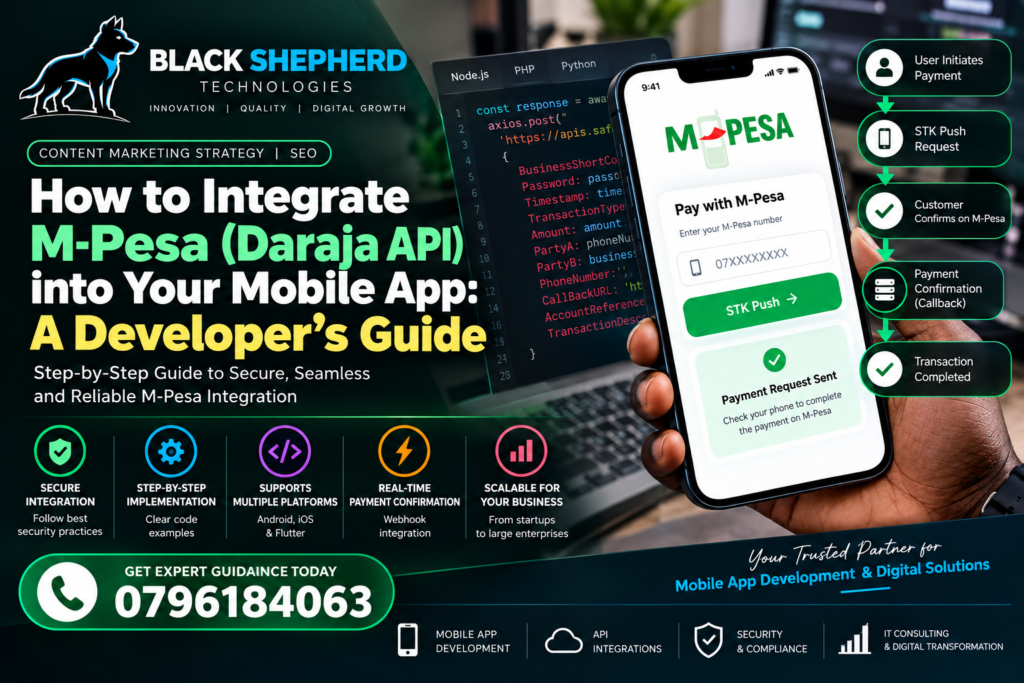
The digital economy across Kenya—thriving from the tech corridors of Nairobi’s Kilimani, Westlands, and Upper Hill to county-level innovation hubs—is expanding at an unprecedented rate. Millions of citizens rely daily on mobile applications for financial transactions through M-Pesa, e-commerce shopping, healthcare access, digital lending, and logistics services.
Yet, with this massive surge in mobile app adoption comes a profound responsibility: data privacy and cybersecurity.
In the past, building a mobile app meant focusing purely on functional features, sleek user interfaces, and fast loading speeds. Today, security and legal compliance are absolute non-negotiables. In Kenya, the full enforcement of the Data Protection Act (DPA), overseen by the Office of the Data Protection Commissioner (ODPC), has transformed data privacy from a theoretical best practice into a strict legal mandate.
Failing to secure your mobile application or violating Kenya’s data protection laws can lead to catastrophic consequences: severe financial penalties, public reputational damage, suspension or removal from the Google Play Store and Apple App Store, and the permanent loss of consumer trust.
How can developers, startup founders, and enterprise executives ensure their mobile applications are secure against modern cyber threats and 100% compliant with Kenya’s Data Protection Act?
This comprehensive guide explores the core pillars of mobile app security, the legal requirements of the ODPC, and a step-by-step roadmap to protecting your users and your business.
Part 1: Understanding Kenya’s Data Protection Act (DPA) and the ODPC
Enacted in 2019 and vigorously enforced in the years following, Kenya’s Data Protection Act established a robust legal framework governing the collection, processing, storage, and transfer of personal data.
For mobile application developers and business owners, the ODPC acts as the primary regulatory watchdog. If your mobile app collects, processes, or stores information about Kenyan citizens—whether they are names, phone numbers, email addresses, precise GPS locations, photos, or financial records—you are legally classified as a Data Controller or Data Processor.
Key Principles of the DPA That Apply to Mobile Apps:
- Lawfulness, Fairness, and Transparency: You must clearly inform users why you are collecting their data and obtain explicit, verifiable consent. Hidden data collection or vague privacy notices are illegal.
- Purpose Limitation: You can only collect data for specific, explicit, and legitimate purposes disclosed to the user. You cannot harvest user contacts or location data for unauthorized secondary uses.
- Data Minimization: Collect only the data that is strictly necessary for your mobile app’s core functionality. If your app is a simple utility or calculator, demanding access to user contacts and photo galleries violates the DPA.
- Storage Limitation: Do not retain personal data indefinitely. Once the data is no longer necessary for the purpose it was collected, it must be securely deleted or anonymized.
- Integrity and Confidentiality (Security): You are legally mandated to implement appropriate technical and organizational security measures to protect personal data against unauthorized access, accidental loss, destruction, or alteration.
Part 2: Essential Mobile App Security Measures for Compliance
To satisfy the ODPC’s mandate for “integrity and confidentiality,” your mobile app architecture must incorporate robust, industry-standard cybersecurity defenses.
1. Secure Data Transmission (Data in Transit)
Mobile applications constantly communicate with backend servers via APIs to fetch user profiles, process payments (such as M-Pesa STK push callbacks), and load content.
- Transport Layer Security (TLS): Ensure that all network traffic between your mobile app and your backend servers is encrypted using modern TLS protocols (TLS 1.3). Never allow unencrypted HTTP traffic.
- Certificate Pinning: Implement certificate pinning within your mobile app code to prevent sophisticated Man-in-the-Middle (MitM) attacks. This ensures your app only trusts your specific server certificate, blocking rogue proxy tools from intercepting API payloads.
2. Secure Data Storage (Data at Rest)
When users input sensitive information—such as authentication tokens, passwords, financial records, or personal identification information (PII)—that data is often cached locally on the device.
- Avoid Plain-Text Storage: Never store sensitive data in plain-text SharedPreferences (Android) or standard NSUserDefaults (iOS), as these can be easily extracted if a device is rooted or jailbroken.
- Leverage Hardware-Backed Security: Utilize secure device storage modules such as EncryptedSharedPreferences on Android and the Keychain on iOS. These solutions leverage the device’s hardware security chip to encrypt local data securely.
3. Robust Authentication and Authorization
Weak authentication mechanisms are the leading entry point for malicious actors seeking to compromise user accounts.
- Token-Based Authentication: Implement secure authentication standards using JSON Web Tokens (JWT) with short expiration lifespans, supported by secure refresh token rotation.
- Multi-Factor Authentication (MFA): For apps handling sensitive financial or health data, enforce biometric authentication (Face ID, fingerprint) or OTP (One-Time Password) verification via SMS or secure messaging channels.
- Principle of Least Privilege: Ensure backend APIs strictly validate user roles and permissions, preventing standard users from accessing administrative or other users’ data endpoints (Insecure Direct Object References – IDOR).
Part 3: Step-by-Step ODPC Compliance Checklist for Mobile Apps
Building a secure app is only half the battle; you must also implement the legal and structural workflows required by Kenyan law.
1. Draft a Clear, Accessible Privacy Policy
Every mobile app that collects personal data must feature a comprehensive Privacy Policy. This policy must be easily accessible within the app settings and via public web URLs submitted to the Google Play Store and Apple App Store.
- What Must Be Included:
- What specific data you collect (phone numbers, location, device info).
- Why you collect it and how it is used.
- Who you share it with (third-party analytics, payment processors like Safaricom or Flutterwave).
- How long you retain the data.
- Contact details for your designated Data Protection Officer (DPO) or grievance redressal channel.
2. Implement Explicit, Frictionless Consent Mechanisms
Under the DPA, pre-ticked consent boxes or buried legal disclaimers do not constitute valid legal consent.
- Just-in-Time Consent: When your app requests sensitive hardware permissions (Camera, Location, Contacts, Microphone), do not demand them all upon initial app launch. Ask for them contextually at the exact moment the user interacts with a feature requiring that permission, accompanied by a clear, human-readable explanation of why the access is needed.
3. Fulfill the Right to Access and Data Deletion
Kenyan citizens have the legal right to know what personal data an application holds about them, and the right to request its complete deletion (“Right to be Forgotten”).
- In-App Account Deletion: Both Apple and Google strictly enforce policies requiring apps with account creation to allow users to initiate account deletion directly from within the app.
- Data Export Tools: Ensure your backend systems can export a user’s data in a readable format if they formally request a copy of their personal records under DPA regulations.
4. App Store Data Safety and Privacy Nutrition Labels
When submitting your app to the Google Play Store and Apple App Store, you must complete mandatory privacy declarations:
- Google Play Data Safety Section: Accurately declare all data collection practices, encryption standards, and sharing policies. Discrepancies between your app’s actual behavior and your declaration will lead to warnings, rejection, or app removal.
- Apple Privacy Nutrition Labels: Complete the App Privacy section in App Store Connect detailing data linked to the user versus data used for tracking.
Part 4: Incident Response and Managing Data Breaches
Even with world-class security protocols, no software system is 100% immune to vulnerabilities or sophisticated cyber attacks. How you handle a security incident under Kenya’s Data Protection Act is legally regulated.
1. Mandatory ODPC Breach Notification
Under the DPA, if a data security breach occurs that poses a risk to the rights and freedoms of data subjects (your users), you are legally required to notify the ODPC within 72 hours of becoming aware of the breach.
2. User Notification Protocols
You must also notify affected users promptly if the breach exposes sensitive personal data (such as financial credentials, identification numbers, or private communications), providing them with actionable steps to secure their accounts.
3. Proactive Monitoring and Crash Reporting
- Real-Time Surveillance: Integrate stability monitoring and security analytics SDKs (such as Firebase Crashlytics, Sentry, or specialized application performance monitoring tools) to detect unusual error spikes, unauthorized API requests, or brute-force login attempts instantly.
Part 5: Why Partnering with Local Experts Matters
Navigating complex cybersecurity frameworks while balancing rigorous compliance under Kenya’s Data Protection Act requires specialized knowledge.
Collaborating with experienced local digital agencies, software development firms, and legal compliance advisors based in Nairobi ensures your mobile application is engineered from day one to withstand local cyber threats and meet all regulatory standards enforced by the ODPC. Local experts understand how data privacy intersects with regional payment APIs (like M-Pesa), cloud infrastructure hosting, and local user expectations.
Conclusion
Ensuring your mobile app is secure and compliant with Kenya’s Data Protection Act is not merely a bureaucratic checkbox to avoid fines—it is a fundamental commitment to your users’ digital safety and your brand’s long-term reputation.
By practicing data minimization, encrypting data in transit and at rest, implementing transparent consent workflows, building in-app account deletion, and maintaining robust monitoring systems, you protect your business and establish deep trust with your target audience.
Are you looking to build, secure, or audit a mobile application for ODPC compliance in Kenya? Connect with industry-leading digital agencies, web designers, and software development experts in Nairobi to safeguard your digital ecosystem today.
