
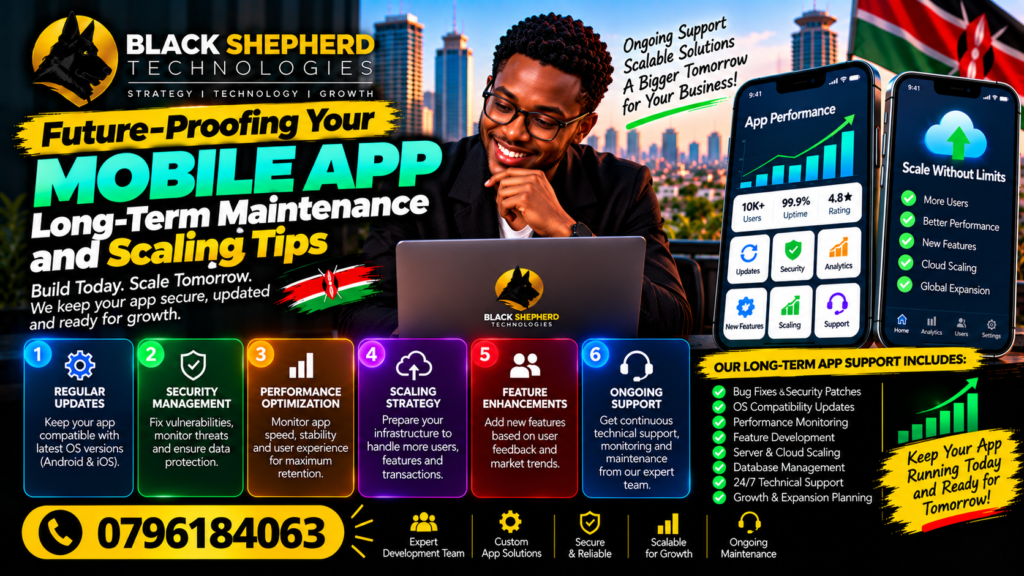
In the fast-paced digital economy—from the bustling tech hubs of Nairobi to global markets—launching a mobile application is frequently viewed as the ultimate finish line. Founders, corporate executives, and business owners pour months of capital, creative energy, and engineering hours into designing, coding, and publishing their app to the Google Play Store and Apple App Store.
Then, launch day arrives. The champagne is popped, initial download metrics spike, and the team breathes a collective sigh of relief.
However, experienced software engineers and successful digital entrepreneurs know a profound truth: Launch day is not the finish line; it is merely the starting line.
An application is not a static digital brochure that you publish and forget. It is a living, breathing software ecosystem. Operating systems update annually (with Apple releasing new iOS versions and Google rolling out major Android upgrades), security threat landscapes evolve constantly, user expectations shift overnight, and business models scale. If your app is not proactively maintained, monitored, and architected for long-term scalability, it will quickly decay into a buggy, obsolete piece of software that users abandon and app stores penalize.
For businesses operating in dynamic markets—where mobile-first innovations drive everything from fintech and e-commerce to logistics and agritech—future-proofing your mobile app is an absolute necessity.
This comprehensive guide explores the essential strategies, technical frameworks, and proactive maintenance practices required to ensure your mobile application scales gracefully, stays secure, and remains competitive for years to come.
Part 1: The Foundations of a Scalable Architecture
Future-proofing begins long before code is written; it is baked into the foundational architecture of your application. If your initial code structure resembles a tangled web of spaghetti code, scaling your app later will be like trying to add a second floor to a house built on sand.
1. Modular Architecture and Clean Code Practices
- Separation of Concerns: Whether you are building natively (Swift/Kotlin) or cross-platform (Flutter/React Native), enforce strict architectural patterns such as MVVM (Model-View-ViewModel), Clean Architecture, or BLoC. This ensures that your user interface layers, business logic, and data access layers are completely decoupled.
- Plug-and-Play Scalability: With a modular codebase, if you decide to swap out a local payment gateway (e.g., updating an M-Pesa API integration or switching SMS notification providers), your engineers can modify a single module without breaking the entire application.
2. Backend Scalability and Cloud Infrastructure
- Cloud-Native Architecture: Avoid monolithic local servers that crash when user traffic spikes. Leverage scalable cloud providers (such as AWS, Google Cloud Platform, or Microsoft Azure) that allow your backend infrastructure to auto-scale dynamically when user demand surges.
- API Versioning: Always version your backend APIs from day one (e.g.,
/api/v1/usersvs/api/v2/users). When you push major updates to your mobile app, older app versions installed on legacy user devices will still be able to communicate with your backend without experiencing catastrophic crashes.
Part 2: Operating System Updates and Platform Compliance
Both Apple and Google update their operating systems annually, introducing new security frameworks, UI paradigms (such as dynamic color schemes or dark mode), and deprecated APIs. Failing to keep pace with these changes guarantees app store penalties or sudden malfunctions.
1. Annual OS Compatibility Cycles
- Proactive Beta Testing: Apple and Google release developer betas months before public OS rollouts. Your development team should test your app against iOS betas and Android developer previews immediately upon release.
- Deprecation Management: Operating systems frequently deprecate older permissions, background tasks, or UI components. Proactively refactor your code to adopt modern standards before older methods stop functioning altogether.
2. Adapting to Evolving App Store Guidelines
- Stricter Privacy and Security Enforcement: App store review guidelines become more stringent every year. Ensuring ongoing compliance with data collection rules, Apple’s Privacy Nutrition Labels, and Google Play’s Data Safety sections prevents sudden app rejection or removal during routine updates.
- Target SDK Requirements: Google Play strictly enforces minimum target API level requirements for new apps and app updates. Missing these compliance windows can prevent you from pushing critical bug fixes.
Part 3: Proactive Performance Monitoring and Error Tracking
You cannot fix what you do not measure. Waiting for users to complain on social media or leave 1-star reviews on the app store before discovering a bug is a recipe for brand suicide.
1. Real-Time Crash Reporting and Analytics
- Stability SDKs: Integrate robust monitoring tools such as Firebase Crashlytics, Sentry, or Bugsnag. These tools instantly alert your engineering team when an unhandled exception or crash occurs in production, complete with stack traces and device logs.
- Performance Monitoring: Track latency metrics, network request durations, and screen rendering speeds. If an API call to fetch product catalogs or process a local payment starts lagging, your team should know before your users notice.
2. Establishing a Continuous Maintenance SLA
- Weekly and Monthly Checkups: Set up a routine maintenance schedule. Weekly reviews of crash analytics and monthly security patch updates ensure your app remains stable.
- Emergency Bug Response Protocol: Define a clear workflow for addressing critical production bugs (such as a broken checkout flow or failed payment gateway callback) within hours of discovery.
Part 4: Security, Data Privacy, and Compliance
As mobile applications handle increasingly sensitive user data—ranging from personal identification information (PII) to financial transactions and mobile money records—security is the ultimate pillar of long-term survival.
1. Adhering to Regional and Global Data Protection Laws
- Local Compliance: In Kenya, apps handling personal data must strictly comply with the Data Protection Act enforced by the Office of the Data Protection Commissioner (ODPC). Globally, similar standards like GDPR and CCPA apply depending on your user base.
- Secure Data Storage: Never store sensitive user tokens, passwords, or financial credentials in plain text. Utilize secure hardware storage solutions such as Keychain (iOS) and EncryptedSharedPreferences (Android).
2. Robust Authentication and Encryption
- Token-Based Authentication: Implement secure authentication mechanisms using JSON Web Tokens (JWT) with short expiration lifespans and secure refresh token rotation.
- End-to-End Encryption: Ensure all data in transit between your mobile app and backend servers is encrypted using modern TLS (Transport Layer Security) protocols. Implement certificate pinning to prevent man-in-the-middle attacks.
Part 5: User Feedback Loops and Continuous Product Evolution
An app that stops evolving becomes obsolete. Future-proofing requires listening closely to your user base and iterating based on real-world usage data.
1. In-App Feedback and Sentiment Tracking
- Frictionless Reporting: Make it effortless for users to report bugs or submit feature suggestions directly from the app’s settings menu rather than venting their frustration on public app store reviews.
- In-App Surveys: Periodically deploy lightweight Net Promoter Score (NPS) surveys to gauge user satisfaction and identify pain points in your user experience.
2. Data-Driven Feature Expansion
- Product Funnel Analytics: Use tools like Firebase Analytics, Mixpanel, or Amplitude to track user journeys. Where are users dropping off? Which screens have the highest abandonment rates? Let data—not guesswork—guide your next feature release.
Conclusion
Future-proofing your mobile app is not a one-time project; it is an ongoing commitment to excellence, security, and adaptability. By establishing a scalable architecture, staying ahead of operating system updates, monitoring performance in real-time, safeguarding user data, and listening to your audience, you transform your mobile app from a temporary project into a enduring digital asset.
Whether you are scaling an enterprise ecosystem or launching a cutting-edge startup, partnering with seasoned digital agencies and web development experts ensures your technology stays robust, secure, and ready for tomorrow’s opportunities.
Looking to build, scale, or maintain a high-performing mobile app or digital platform? Connect with leading digital agencies and web design specialists in Nairobi to future-proof your digital presence today.
