
In the bustling digital economy of Kenya, from the tech-forward boardrooms of Nairobi’s Upper Hill and Westlands to the vibrant commercial hubs of Mombasa, Kisumu, Nakuru, and Eldoret, businesses are fighting tooth and nail for online visibility.
Imagine a potential customer searching for your exact product or service on Google. When the search engine results page (SERP) loads, your competitor’s listing features gleaming star ratings, rich product images, precise pricing, operating hours, and a clear FAQ dropdown. Your listing? Just a plain blue link and a generic meta description.
Which result do you think the user will click?
In almost every scenario, the user will click the enriched result. That visual advantage is not magic—it is Schema Markup.
For Kenyan business owners, marketing managers, and web designers, understanding and implementing schema markup is no longer an optional technical nuance; it is a critical competitive edge. This comprehensive guide explores what schema markup is, why it matters in the Kenyan digital market, and how you can implement structured data to make your website stand out on Google search.
1. What is Schema Markup and How Does It Work?
To understand schema markup, you first need to understand how search engines view the internet. When Googlebot crawls a web page in Kenya—whether it is an e-commerce store selling electronics in Nairobi or a boutique hotel in Diani—it reads the raw HTML code.
While humans can easily look at a web page and recognize that “Ksh. 5,000” is a price, “Nairobi, Kenya” is a location, and “Dr. Ochieng” is an author, search engines need help connecting the dots.
Schema markup (also known as structured data) is a standardized code vocabulary (created via Schema.org through a collaboration between Google, Bing, Yahoo, and Yandex) that you add to your website’s HTML. It acts as a translator, telling search engines explicitly what your data means, not just what it says.
The Visual Power of Rich Snippets
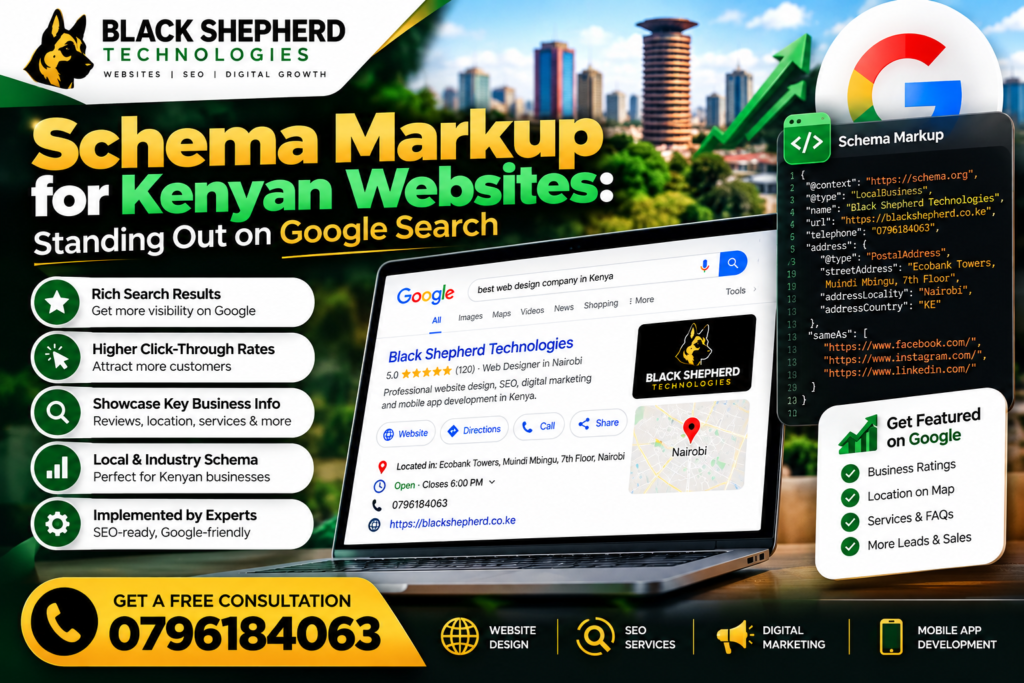
When you implement schema correctly, Google rewards your website by displaying Rich Snippets in search results. These enhanced listings can include:
- Star ratings and customer review counts.
- Product availability and pricing in Kenyan Shillings (KES).
- Event dates, ticket prices, and venue locations.
- Breadcrumb navigation trails.
- FAQ accordions right below your search result.
- Organization details and local business knowledge graphs.
By giving search engines clear, structured context, you dramatically improve your click-through rate (CTR), driving more organic traffic without necessarily having to rank higher in raw position.
2. Why Schema Markup Matters Specifically for Kenyan Businesses
Kenya’s internet users are sophisticated, mobile-first, and demanding. They expect instant answers, verified credibility, and clear transactional details before engaging with a brand. Here is why schema markup is uniquely powerful in the Kenyan market:
A. Dominating Local Search and Maps Integration
Kenyan consumers frequently use localized queries like “best hardware store near me” or “law firms in Nairobi open now.” Implementing LocalBusiness Schema ensures that Google extracts your physical address, phone number, operating hours, and geo-coordinates accurately. This feeds directly into the Google Local Pack and Google Maps, giving your business a massive local advantage.
B. Building Immediate Trust in E-Commerce and Services
Online fraud concerns and skepticism still exist among digital buyers in East Africa. When an e-commerce website displays customer reviews, star ratings, and stock availability directly on Google search, it instantly signals legitimacy and builds trust before the user even lands on your site.
C. Maximizing SERP Real Estate on Mobile Devices
With over 80% of web traffic in Kenya originating from mobile smartphones, screen real estate is at a premium. Rich snippets, FAQ schema expansions, and breadcrumbs make your search listing physically larger on a mobile screen, pushing competitor listings further down and capturing user attention.
3. Essential Types of Schema Markup for Kenyan Websites
There are hundreds of schema types available on Schema.org, but certain categories deliver the highest return on investment for businesses operating in Kenya.
I. LocalBusiness Schema
Crucial for brick-and-mortar stores, professional service firms, clinics, hotels, and agencies. It defines your geographic identity.
- Key properties: Name, address, telephone, geo-coordinates (latitude/longitude), opening hours, price range, and service area.
II. Product and Offer Schema
Indispensable for e-commerce platforms and retail websites.
- Key properties: Product name, brand, SKU, product image, customer reviews/ratings, currency (KES), availability status (InStock, OutOfStock), and price.
III. Organization Schema
Helps establish your corporate identity, logo, social media profiles, and contact details in Google’s Knowledge Graph. Perfect for corporate firms, NGOs, and educational institutions.
IV. Article and BlogPosting Schema
Vital for media houses, corporate blogs, and content publishers across Kenya. It tells Google who wrote the article, when it was published, and what images belong to it, increasing your chances of appearing in Google Top Stories and Discover feeds.
V. FAQ Schema
Allows you to display expandable frequently asked questions directly on the search results page. This is one of the most effective ways to expand your SERP footprint and answer immediate user queries.
4. How Schema Intersects with Web Design and SEO
Many web designers treat schema markup as an afterthought or skip it entirely, focusing solely on visual aesthetics. However, technical SEO and schema implementation must be embedded directly into your website’s architecture from day one.
Professional agencies that understand industries we serve recognize that a manufacturing plant, a real estate agency, and an e-commerce retailer each require completely different schema implementations. For example, real estate sites need RealEstateAgent and Place schema, while hospitality sites need Hotel and LodgingBusiness schema.
Furthermore, businesses looking to upgrade their digital footprint can review past portfolios and project showcases to see how robust technical SEO foundations—including structured data—translate into superior search visibility and higher conversion rates.
5. Step-by-Step Guide to Implementing Schema Markup
Implementing schema markup can be done in several ways depending on your technical expertise and content management system (CMS).
Step 1: Choose Your Markup Format
Google prefers JSON-LD (JavaScript Object Notation for Linked Data). It is a lightweight script inserted into the <head> or <body> of your HTML document that search engines can easily parse without slowing down your page render time. (Avoid older microdata formats embedded directly inside HTML tags if possible).
Step 2: Generate the Code
You don’t need to write JSON-LD code from scratch. You can use Google’s official Structured Data Markup Helper or free online schema generators.
- Select the data type (e.g., Local Business or Article).
- Fill in the required fields (Business Name, Address, Phone, Image URL, etc.).
- Generate the HTML/JSON-LD script.
Step 3: Insert the Schema into Your Website
- If using WordPress: You can use powerful SEO plugins like Rank Math, Yoast SEO, or Schema Pro, which automatically generate appropriate schema markup for your posts, products, and local business pages.
- If using custom code: Paste the generated JSON-LD script directly into the header section of your HTML templates.
Step 4: Validate Your Markup
Never assume your schema is correct until you test it. Use Google’s Rich Results Test or the Schema Markup Validator. Paste your URL or code snippet into the validator to check for syntax errors, missing required properties, or warnings.
6. Common Schema Mistakes to Avoid
Even experienced web developers occasionally make mistakes that prevent rich snippets from appearing on Google. Watch out for these common pitfalls:
- Markup Mismatch: Creating schema that does not match what is visibly written on the page (e.g., displaying a 5-star rating in your schema when no reviews exist on the page). Google penalizes misleading structured data.
- Syntax Errors: Missing a comma, bracket, or quotation mark in your JSON-LD script will break the entire code block, rendering it invisible to search crawlers.
- Ignoring Google Search Console Warnings: After implementing schema, monitor Google Search Console’s “Enhancements” tab regularly. Google will alert you if any structured data items have errors or warnings.
- Over-Optimizing or Spamming: Do not mark up content that is hidden from the user or irrelevant to the page topic.
Partnering with experts who provide comprehensive SEO services in Kenya ensures that your technical schema implementation is error-free, fully compliant with Google guidelines, and optimized for maximum search impact.
7. The Future of Search: Schema, AI, and Semantic Web
As search engines evolve into AI-driven answer engines (such as Google Search Generative Experience and AI Overviews), the importance of structured data is skyrocketing. AI models rely heavily on semantic relationships, entities, and structured data graphs to synthesize answers for users.
When you implement clean schema markup on your Kenyan website, you are not just helping Google today—you are future-proofing your digital presence for the AI search era. Your business becomes an easily readable, verified entity that AI models can trust and cite in their conversational search summaries.
Conclusion: Stand Out on Google Search Today
In Kenya’s competitive digital landscape, blending in is a recipe for obscurity. While your competitors rely solely on basic keywords and standard web design, implementing advanced schema markup gives your website the superpower of rich snippets, enhanced trust, and dominant search visibility.
Whether you run an enterprise in Nairobi, a coastal enterprise in Mombasa, or a growing digital brand anywhere in Kenya, structured data is your direct line of communication with Google.
Ready to make your website stand out, attract higher-quality traffic, and outrank your competitors? Explore our specialized industries we serve, view our proven track record in our portfolios and project showcases, and elevate your digital authority today.
Transform your search engine listings and dominate Google search results. Visit Black Shepherd Kenya today to start your advanced SEO and schema optimization journey.