
The digital economy across East Africa is booming. From the vibrant tech and startup ecosystems of Nairobi’s Kilimani, Westlands, and Upper Hill to thriving commercial enterprises in Mombasa, Kisumu, Nakuru, and Eldoret, mobile applications have transitioned from luxury corporate experiments into core revenue-generating assets. With smartphone adoption soaring and mobile money transactions via M-Pesa driving trillions of shillings annually, businesses are racing to secure their footprint on customer mobile screens.
However, embarking on a mobile app development project is a major strategic and financial commitment. Choosing the right development partner in Kenya can mean the difference between launching a market-leading digital product that scales gracefully and watching your capital vanish into an unmaintainable codebase, missed deadlines, and endless bug cycles.
With dozens of agencies, software houses, and freelance syndicates operating across the region, how do you separate elite engineering partners from amateur operations?
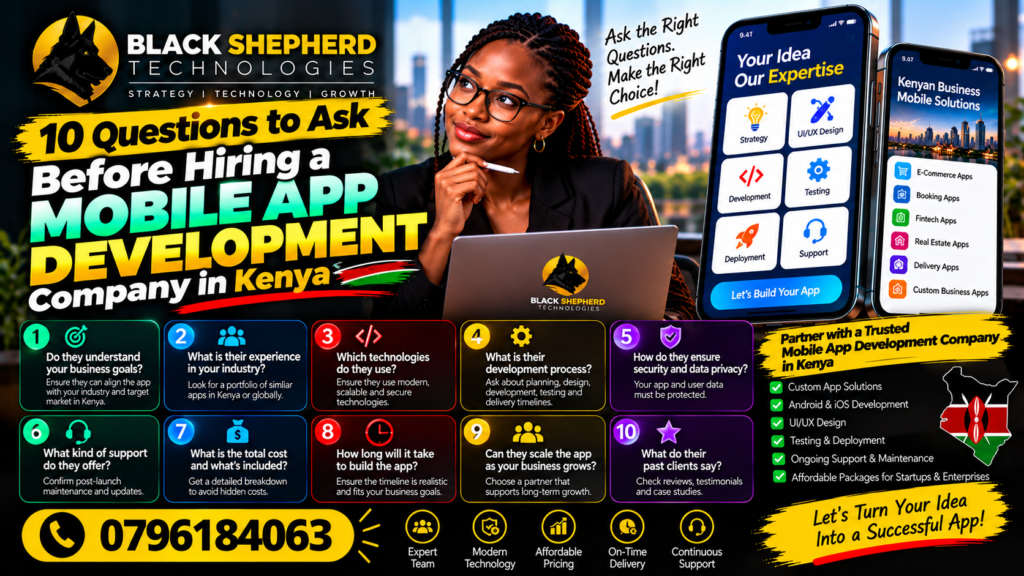
You ask the right questions. Before signing any contract or wiring your initial deposit, you need a rigorous interrogation framework. In this comprehensive guide, we outline the 10 essential questions you must ask before hiring a mobile app development company in Kenya, ensuring your investment is protected, your timelines are met, and your product is engineered for exceptional ROI.
Question 1: “Can You Show Me Live Apps You Have Built and Published on the App Stores?”
Talk is cheap, but deployed code speaks volumes. Many digital agencies will present stunning PowerPoint presentations, conceptual mockups, and sleek UI wireframes. However, designing a screen in Figma is vastly different from engineering a secure, high-performance application that passes the rigorous automated and manual reviews of the Google Play Store and Apple App Store.
What to Look For:
- Live Links: Demand direct links to applications they have designed, developed, and successfully published that are currently active in the app stores.
- Relevant Industry Experience: Have they built apps in your specific sector (fintech, e-commerce, logistics, agribusiness, healthcare)?
- User Reviews: Check the store listings yourself. What do real users say about the app’s performance, load speeds, and stability?
To review verified examples of production-grade digital solutions and mobile deployments, explore our portfolio and completed projects showcase.
Question 2: “How Do You Handle M-Pesa and Local API Integrations?”
In Kenya, an application that cannot process mobile money seamlessly is commercially dead on arrival. M-Pesa is the financial circulatory system of the country. Whether you are running an e-commerce platform, a micro-lending app, or a service-booking utility, your application must integrate flawlessly with Safaricom’s Daraja API (Lipa Na M-Pesa STK push) and other regional financial gateways.
What to Look For:
- Deep Technical Competency: Ask the agency how they handle API timeouts, failed webhook callbacks, and offline transaction retries.
- Security Protocols: Ensure they follow strict encryption and tokenization standards to protect sensitive financial data during transmission.
- Error Handling: A naive developer sets up a basic API connection that breaks the moment Safaricom updates its gateway endpoints. An experienced Kenyan agency builds resilient architecture with robust error handling to guarantee transaction continuity.
Question 3: “What Is Your Approach to UI/UX Design for the Local Audience?”
User Experience (UX) dictates whether a customer stays or deletes your application within the first 30 seconds. In Kenya, mobile users operate in a unique environment characterized by specific device preferences, data bundle considerations, and behavioral habits.
What to Look For:
- Data Efficiency: Do their interface designs avoid bloated animations and heavy, uncompressed imagery that drains a user’s mobile data bundle?
- Device Fragmentation Handling: Do they optimize layouts for the massive variety of Android devices prevalent in Kenya—ranging from budget Tecno, Infinix, and Itel handsets to Samsung and high-end Xiaomi models—alongside iOS devices?
- Intuitive Workflows: Do their UI designs reflect local consumer psychology, fostering immediate trust through transparent pricing in Kenya Shillings (KES), clear verification badges, and accessible customer support contacts?
Question 4: “Will You Build Native or Cross-Platform, and Why Is That Best for My Business?”
The technology stack chosen for your mobile app determines its speed, scalability, maintenance costs, and long-term viability. Agencies should not use a one-size-fits-all approach; their recommendation should align with your specific business goals and budget.
What to Look For:
- Cross-Platform Frameworks (Flutter / React Native): For 90% of startups and growing enterprises, cross-platform frameworks backed by tech giants (such as Google’s Flutter) provide the optimal balance—allowing a single codebase to deploy seamlessly across both iOS and Android with native-level performance while cutting development costs and timelines by nearly 50%.
- Native Development (Swift / Kotlin): For apps requiring heavy 3D graphics, complex hardware-level processing, or high-frequency gaming, native development is essential.
- Transparent Justification: Ensure the agency explains why they recommend a specific stack rather than just pushing whatever language their current developers happen to know.
Question 5: “What Does Your Discovery and Scoping Phase Look Like?”
A red flag in software development is an agency that quotes you a price and timeline instantly over a casual phone call or WhatsApp message before understanding your core business logic. Professional development requires a rigorous discovery phase.
What to Look For:
- Comprehensive Requirement Gathering: Do they take time to map out user personas, feature prioritization (MVP scoping using frameworks like MoSCoW), database entity-relationship diagrams (ERDs), and technical architecture blueprints?
- Detailed Project Roadmaps: A professional agency provides a documented Statement of Work (SOW) outlining exact milestones, deliverables, sprint cycles, and acceptance criteria.
- Risk Identification: Do they proactively identify potential bottlenecks in your business model or technical requirements before a single line of code is written?
Question 6: “How Do You Ensure Compliance with Kenya’s Data Protection Act (2019)?”
Operating a digital application in Kenya requires strict adherence to legal frameworks, particularly if your app collects user phone numbers, physical locations, financial history, or personal identifiers.
What to Look For:
- Familiarity with the ODPC: Does the development team understand the mandates of the Office of the Data Protection Commissioner (ODPC)?
- Secure Architecture: Do they implement end-to-end data encryption, secure token-based user authentication (OAuth 2.0), and secure cloud server configurations?
- Data Privacy Policies: Can they guide you in drafting legally compliant in-app privacy policies and user consent mechanisms?
Question 7: “What Is Your Quality Assurance (QA) and Testing Process?”
Nothing destroys a brand’s reputation faster than launching an app riddled with crashes, broken layouts, and unresponsive buttons. Rigorous quality assurance is the shield that protects your users from experiencing bugs firsthand.
What to Look For:
- Dedicated QA Engineers: Ask if they have independent QA testers whose sole job is to break the application, or if they rely entirely on the programmer to test their own code.
- Real-Device Testing: Do they test across an array of physical devices running different OS versions, screen dimensions, and hardware specs?
- Network Throttling Tests: Do they test how your app behaves when a user moves from stable office Wi-Fi down to patchy 3G or 2G network conditions in a moving matatu or upcountry county?
To understand how professional development aligns with broader digital infrastructure and search visibility, explore our industries we serve.
Question 8: “Who Owns the Source Code and Intellectual Property (IP) Upon Completion?”
This is a critical legal and commercial question. Some low-cost agencies or freelance developers lock your source code behind proprietary frameworks or retain ownership, holding your application hostage if you ever want to transition to an internal development team or a new agency.
What to Look For:
- Full IP Transfer: The contract must explicitly state that upon final payment completion, 100% of the source code, intellectual property rights, UI/UX design files (Figma/Adobe XD), and admin dashboard credentials belong entirely to you.
- Repository Access: Ensure your code is hosted on a secure version control repository (such as GitHub or GitLab) under your own organization account from day one.
Question 9: “What Support and Maintenance (SLA) Do You Offer After Launch?”
Software is never truly “finished.” Operating systems update annually (Apple iOS updates and Android system upgrades), security patches drop continuously, and user feedback will demand iterative feature enhancements.
What to Look For:
- Warranty Period: Do they offer a bug-fixing warranty period (e.g., 30 to 90 days post-launch) at no extra cost to squash any post-deployment anomalies?
- Service Level Agreements (SLAs): Do they offer ongoing monthly or annual maintenance packages to monitor server uptime, patch security vulnerabilities, and handle OS compatibility updates?
- Response Times: What is their guaranteed response time when an emergency bug or server downtime occurs?
Question 10: “How Does This App Integrate into My Broader Digital Ecosystem?”
A mobile app should never exist in an isolated silo. To maximize your return on investment (ROI), your app must connect harmoniously with your website, search engine rankings, CRM systems, and digital marketing funnels.
What to Look For:
- Holistic Digital Expertise: Does the agency understand how web presence and mobile ecosystems work together? When users search for your services online, your web assets should rank on search engines and funnel them seamlessly toward downloading your mobile app.
- Comprehensive Growth Services: Partner with agencies that offer integrated digital solutions, including professional SEO services in Kenya to drive organic web traffic that converts into active mobile app users.
Conclusion: Partnering for Long-Term Success
Choosing a mobile app development company in Kenya is a foundational decision that will shape your commercial trajectory for years to come. By asking these 10 rigorous questions, you strip away marketing fluff, test technical competence, verify legal protections, and ensure your development partner is fully equipped to turn your vision into a secure, scalable, market-leading digital asset.
Take your time, demand transparency, and partner with a team that treats your application not just as a coding project, but as a core revenue-generating business driver.
Ready to partner with an experienced, multidisciplinary digital agency engineered for exceptional results? Explore our industries we serve or examine our portfolio projects to discover how we bring transformative mobile and web solutions to life.